Cost-effective environmental imaging services combining camera drone and cloud technology
As a drone Operator and Pilot registered with the Civil Aviation Authority (CAA) in the UK I’m able to offer a variety of commercial services in open countryside locations.
Mapping
On one privately owned site in the Surrey Hills AONB, 32 hectares (79 acres) of part ancient, mixed broadleaf woodland was mapped on behalf of the owner and land manager.
Thousands of individual images were stitched together to create an orthomosaic, which was then exported as individual GeoTIFF tiles compatible with GIS software. Very high resolution single images can also be generated (2cm/pixel).
Mapping missions were flown at different times of year to observe seasonal variation.
Analysis
Spectral analysis techniques allow aerial imagery to be used for environmental monitoring at landscape scale. The image below compares visual spectrum vs. enhanced NDVI processing to study plant health.
Visual spectrum vs. NDVI showing replanted woodland
Change detection
Orthomosaic images facilitate accurate measurement to inform effective land management. The aerial map below quickly measured the extent of a heathland fire at Thursley Common NNR in Surrey for Natural England.
Aerial drone map showing extent of Thursley NNR heath fire
Monitoring
Below is an aerial survey of a Homes England residential development at the point where a new access road crosses a river valley intended to form a ‘green corridor’ for wildlife. Orthomosaic, NDVI and elevation visualisations are compared.
This short animation shows the image resolution (~2cm/pixel) attained from the same drone survey mission flown at an altitude of 100m.
Timelapse
By layering orthomosaic images created in different seasons it’s possible to create a wide area timelapse sequence, as shown below.
Drone vs. satellite
Drones and satellites offer complementary technologies for aerial imaging, but camera drones enjoy a few advantages:
Resolution Satellites cannot compete with drones for detail. Satellite images will allow you to see individual trees, but with a drone it’s possible to distinguish each leaf.
Perspective Satellites are restricted to flat overhead perspectives. A well-operated drone can film or photograph any subject from almost any angle. This can assist in the capture of digital elevation models using 3D point clouds.
Urgency You don’t need to wait for cloud cover to clear before flying a drone survey! If clouds obscure your satellite image you have no option but to schedule another attempt… and cross your fingers.
One very soggy White Admiral caterpillar this evening, draped across his former hibernaculum. There were streams in the wood where I haven't seen water before. 🦋🐛⛈️ #WhiteAdmiralWatchpic.twitter.com/LDmxvXKG7S
The reason for Rollo’s delayed development becomes clear…
A fly was over-eager to pay its last respects to my parasitised White Admiral caterpillar. But even in this near-fatal condition Rollo summoned the energy to lash out with his head! #WhiteAdmiralWatchpic.twitter.com/RgCOWbHhxg
White Admiral butterfly metamorphosis: from larva to prepupa to pupa to imago.
In Sussex during the COVID-19 epidemic of 2020 I followed one very special butterfly through pupation to emergence
The White Admiral (Limenitis camilla) is a large woodland butterfly which glides effortlessly along forest rides. Its numbers in the UK have rebounded since the First World War, possibly due to the cessation of coppicing which, unusually, has benefited this species since its larvae require Honeysuckle growing in shady woodland.
28 May
My first, long awaited, encounter with ‘Camilla’ came on 28 May when my many searches of Honeysuckle vines finally bore fruit and this magnificent creature suddenly greeted me.
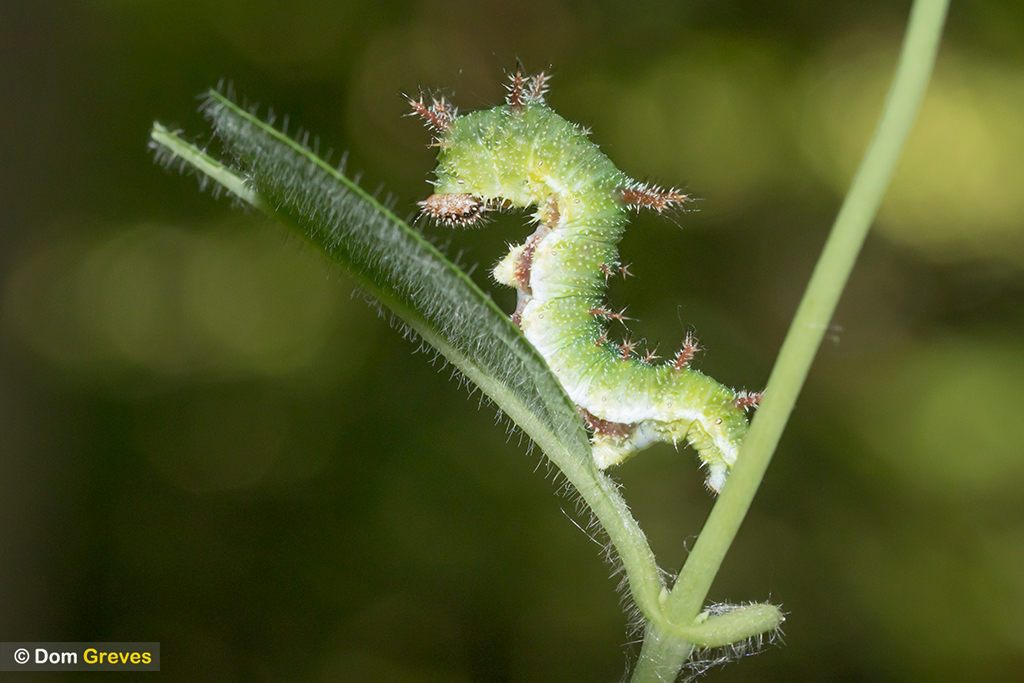
White Admiral (Limenitis camilla) 5th instar caterpillar on honeysuckle (Lonicera periclymenum).
White Admiral caterpillars are entirely dependent on Honeysuckle for their survival, feeding on its leaves through all five larval instars and hibernating within their folds.
At more than 2 cm in length this was a fifth and final stage caterpillar, exotic in appearance compared to the majority of British butterfly larvae, adorned with branching red spines along its back and resting in a raised serpentine position.
31 May
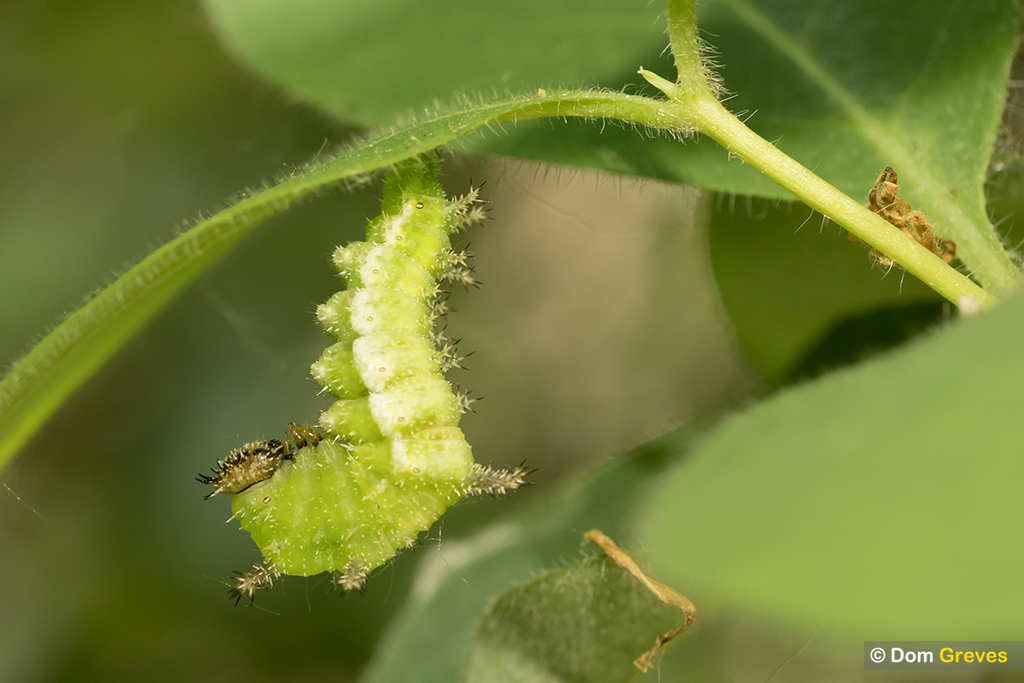
When I returned 3 days later Camilla was already preparing to pupate, hanging beneath a Honeysuckle leaf, suspended from her hind claspers attached to a pad of silk.
White admiral (Limenitis camilla) prepupa suspended from honeysuckle (Lonicera periclymenum).
2 June
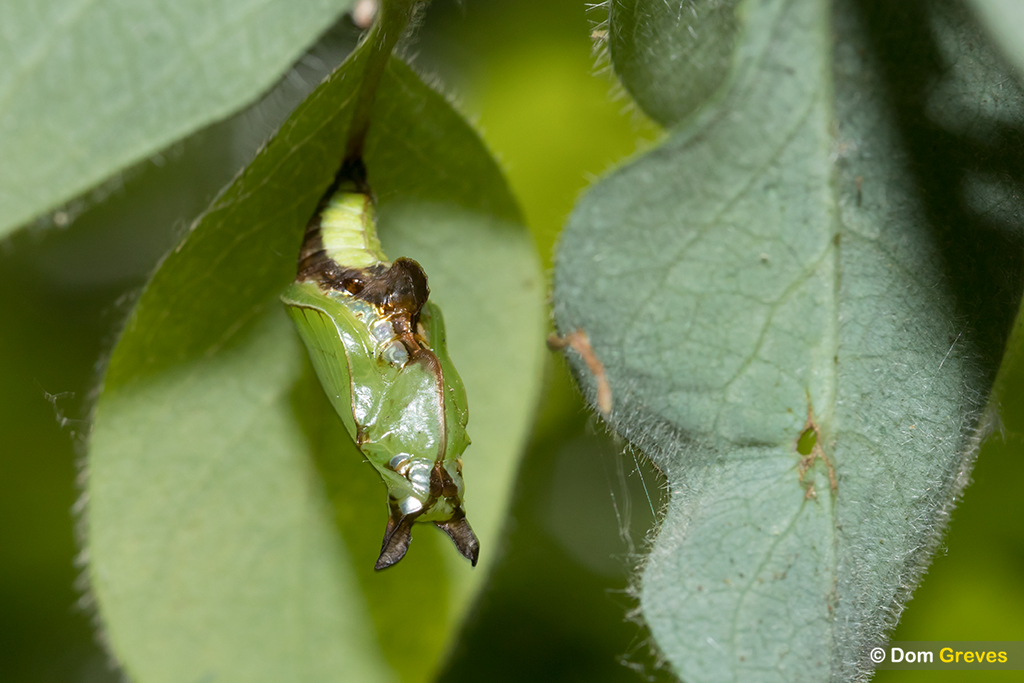
48 hours later the pupa was now fully formed, with two prominent horns on the head and an odd protrusion further back.
“The pupa bears a close resemblance to a profile portrait of Punch.”
– Frohawk (1924)
White admiral (Limenitis camilla) pupa suspended from honeysuckle (Lonicera periclymenum). Day 1.
7 June
The pupa darkened up a little in the next few days, its undulations mimicking the Honeysuckle leaves quite convincingly.
White admiral (Limenitis camilla) pupa suspended from honeysuckle (Lonicera periclymenum). Day 6.
For the next two weeks few visible changes occurred and the weather turned cold and wet. A marauding army of small birds came and went, leaving Camilla thankfully undisturbed.
23 June
Around Day 22 the folded wing veins became a bit more pronounced beneath the pupal case and its body seemed to have plumped up a bit. Warm, sunny weather had returned to the woodland glade.
White admiral (Limenitis camilla) pupa suspended from honeysuckle (Lonicera periclymenum). Day 22.
24 June
Revisiting on the morning of Day 23 I found Camilla had darkened up overnight, turning from green to brown, signalling that ‘eclosion’ of the adult butterfly was imminent.
White admiral (Limenitis camilla) pupa suspended from honeysuckle (Lonicera periclymenum). Day 23 (AM).
By 5pm that afternoon my ‘White’ Admiral was now distinctly black!
White admiral (Limenitis camilla) pupa suspended from honeysuckle (Lonicera periclymenum). Day 23 (PM).
From a different angle the butterfly’s wing structure and patternation could clearly be seen.
“Before emergence it turns to a bronze-black all over, losing almost all the metallic lustre of silver-gilt; the white wing markings of the imago show pale amber colour through the pupal skin.”
– Frohawk (1924)
White admiral (Limenitis camilla) pupa suspended from honeysuckle (Lonicera periclymenum). Day 23 (PM).
I was hopeful the adult butterfly would emerge that evening and so remained until well after dusk, but as it grew dark I was forced to return home for the night.
25 June
Back on site very early next morning I was relieved to discover that the big moment had yet to arrive.
Camilla remained suspended from the Honeysuckle leaf until 09:11 on Day 24 when she suddenly popped out of her chrysalis in the blink of an eye, annoyingly while my back was briefly turned!
White admiral (Limenitis camilla) imago newly hatched. Day 24.
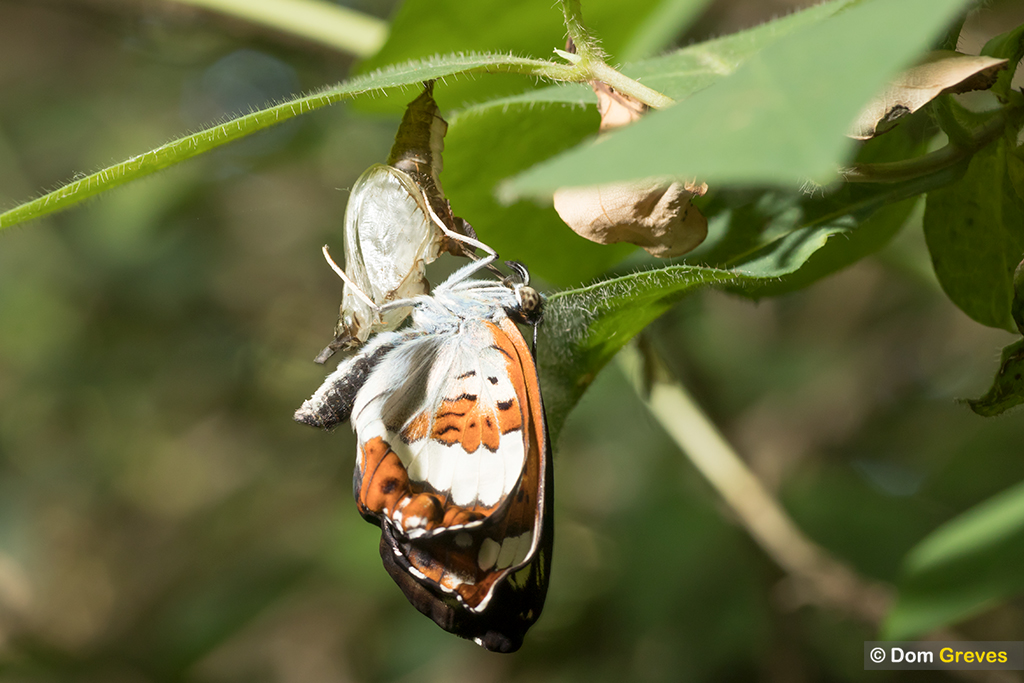
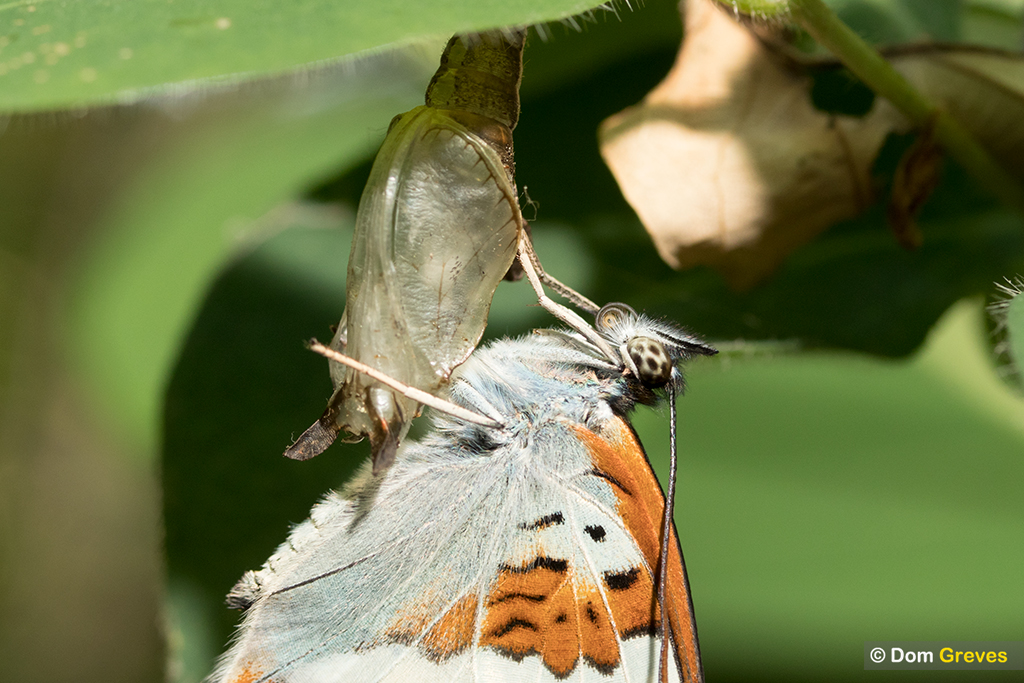
Camilla luxuriated in the warm morning sunlight streaming through the oak canopy, slowly expanding her glorious wings as she clung to the vacant ‘exuvia’.
White admiral (Limenitis camilla) imago newly hatched. Day 24.
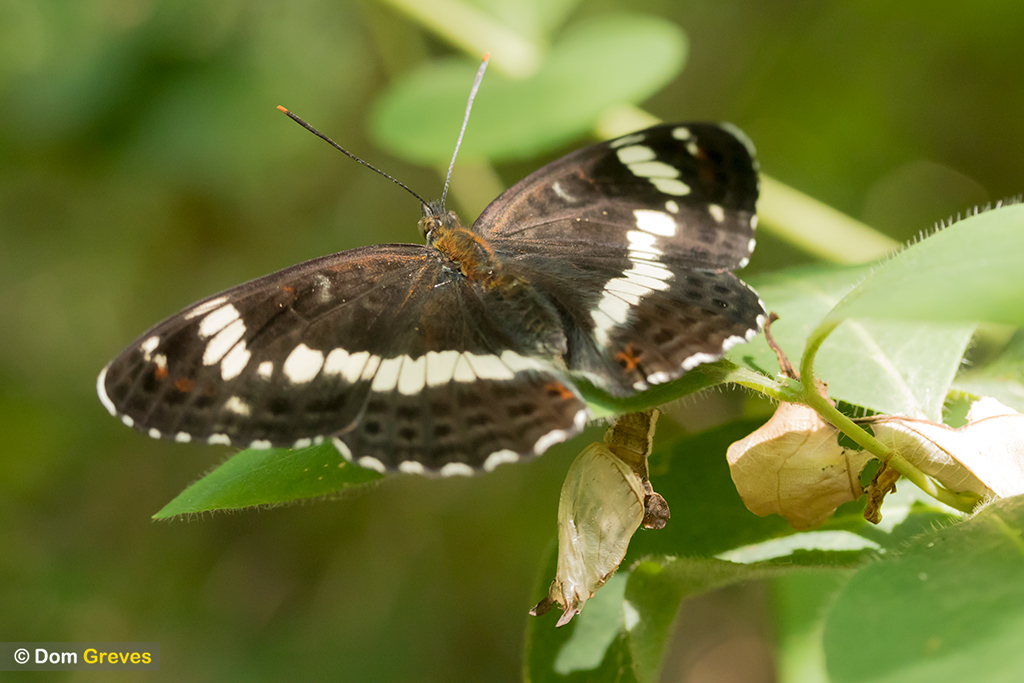
By 10:50 her wings were fully expanded and at 11:12, two hours after emergence, she clambered nimbly up onto the Honeysuckle leaf which had supported her pupa through sun and rain, heat and cold, for the past 24 days. It would now become her launching pad.
White admiral (Limenitis camilla) imago shortly before first flight.
And then 8 minutes later, at 11:20 she flew for the first time… and was gone!
Video showing newly emerged White Admiral (Limenitis camilla) butterfly drying its wings before takeoff.
Except that I strongly suspect she hung around…
I only witnessed one other adult White Admiral in the wood that summer. The individual photographed below frequented Bramble blossom within metres of Camilla’s hatching site, sunning itself on the woodland floor nearby and alighting on Honeysuckle, likely assessing suitable spots to lay her eggs for the next generation of White Admiral caterpillars to emerge.
White admiral (Limenitis camilla) butterfly nectaring on bramble flowers.
You’d think that arachnids and water was an unhappy combination, but one species of European spider has made boggy ponds their home.
The raft spider (Dolomedes fimbriatus) is the UK’s largest native spider – its body growing up to 2cm long.
It uses the water’s surface like other spiders use their webs – feeling for the vibrations of potential prey with front legs extended. Using this technique it hunts tadpoles, insects and occasionally small fish:
Raft spider eating damselfly
When alarmed, the water repellent hairs on the raft spider’s legs enable it to dive beneath the water, trapping a bubble of air to keep it alive until the coast is clear and it cautiously re-emerges:
The wetland pools favoured by raft spiders are increasingly rare in this country. On the RSPB’s Arne reserve in Dorset their habitat is lovingly preserved, and offers wildlife watchers easy access from the nearby heathland trail:
Boggy pond habitat
On a good day dozens of raft spiders at various stages in their life cycle can be witnessed at the pond’s edge.
1. Sex
The female raft spider is often considerably larger than the male and mating is a dangerous business. He approaches her cautiously, waving his front legs tentatively to judge her receptiveness:
Male raft spider approaches female at her den
She may rush out to scare him off on numerous occasions, after which she retreats and the process begins again, the male edging closer all the while. It’s a nerve jangling thing to watch, let alone participate in.
2. Birth
The female spins a silk bag to contain the fertilised eggs, which she carries about beneath her body, keeping it just warm and moist enough to ensure their survival:
Raft spider carrying egg sac
Then, when the baby spiders are ready to hatch, she lashes the egg sac to vegetation at the edge of the pond and the tiny hatchlings emerge:
Baby raft spiders in nursery web
Mum typically lies in wait nearby to ensure that her young ones don’t come to any harm:
Raft spider guards her hatchlings
This phenomenon of hundreds of spiderlings crowded together for their own mutual safety is only really appreciated up close:
Raft spider hatchlings closeup
But soon the young raft spiders are large enough to fend for themselves and disperse around the pond.
3. Death
Raft spiders are not fussy eaters. When times are tough and food is scarce, or when too many raft spiders compete for the same local resources, they may even turn to cannibalism:
Purple Emperor butterfly (Apatura iris) feasting on fresh dog turd
Such a beautiful creature with such un-photogenic habits! Infamously the Purple Emperor butterfly (Apatura iris) spurns the sweet nectar of wildflowers in favour of dog faeces amongst other delicacies.
Now mostly confined to the ancient deciduous woodlands of Surrey and Sussex in the UK, the Purple Emperor has a devoted following in the world of butterfly fans.
Normally it flies high in the woodland canopy and only occsionally will the male descend to the ground to replenish its liquids and salts in this peculiar fashion. On these rare occasions the Emperor’s acolytes fill their boots.
Here on Bookham Common in Surrey, within sight and sound of the M25 motorway, the lack of a long lens is no handicap when this butterfly is distracted by a fresh deposit:
Purple Emperor posing for a mobile phone photograph
The less exotically coloured female at least has more refined tastes, and generally remains high in the oak trees feeding on the sticky sweet honeydew secreted by aphids. She returns a little closer to earth only to lay her eggs in a suitable sallow tree nearby.
Female Purple Emperor laying eggs on willow sapling
Such is the lure of the Purple Emperor that fanatics have been known to entice ‘His Majesty’ down from the trees with a number of foul smelling concoctions. In the absence of dung a rotting carcass may occasionally do the trick. This recently deceased rodent at a favourite butterfly haunt in the wood may have benefited from a coroner’s inquest:
If you’re looking for a photographic challenge then wildlife macro at night is guaranteed to keep you amused and frustrated in equal measure.
Glow worms (Lampyris noctiluca) come equipped with their own bioluminescent light source, and with a bit of research shouldn’t be too difficult to locate in the right environment. But in the dark simple tasks become considerably more complicated.
These ‘worms’ are in fact a beetle. On summer nights the flightless female glow worm climbs a grass stem, or other vegetation, and emits a bright chemical light from her lower abdomen. This luminous display attracts the flighted male glow worm and mating begins, at which point the happy couple turn out the light and retire to bed together in the undergrowth.
In the UK glow worm numbers – or at least the number of people reporting them – have diminished over the years. Light pollution from sprawling urban areas may be one reason for this, as the female doesn’t like competition, and seeks out the darkest rural recesses in which to display to potential mates. The inexorable rise of the motorcar has also meant fewer people traversing the countyside on foot at night, and so less likelihood of happening across these creatures. Modern use of pesticides may also have played a part.
The wilds of South Dorset proved good hunting grounds for me last year and I was keen to have another crack at this subject in Surrey over the summer.
Initial research turned up not much however. Almost every contact I quizzed looked at me with bafflement and a little wonder when I enquired about glow worms in the county, as if they’d become semi-mythical beasts in this stretch of the London commuter belt. A bit of Googling turned up a handful of vague mentions and precious few images.
The excellent UK Glow Worm Survey website, run by the extremely dedicated Mr Robin Scagell, offered more precise records and this especially tantalising glimpse of days gone by:
Box Hill, nr. Burford Bridge, Whole slope of Hill covered with glow-worms, summer 1915
Promising, but a long shot more than 90 years later perhaps. Then a chance meeting with a twitcher confirmed glow worms sighted in a very specific area of the hillside in the 1980s and the balance of probabilities swung in favour of action!
From my vantage point atop the steep chalk slope of Box Hill the sun began to set impressively, and the exhausting vertical scramble required to get there faded into memory.
Tight security in preparation for the Olympic cycle race meant that the entire National Trust property was ringed with high steel barriers. A checkpoint restricted traffic up the narrow zig-zagging road to the top, and guards with walkie-talkies patrolled its length. The pedestrian gates thankfully remained open.
Town of Dorking in Surrey from Box Hill after dark
Bright lights from the dual-carriageway below continued to illuminate the entire downland slope after the sun had faded, which wasn’t promising. But in a deep, shady dip behind the ridge a twinkling greenish light in the grasses finally caught my eye.
In total 8 glowing females were located along a short stretch of chalk track.
The first young lady was tucked well back into the shrubbery and inaccessible to my lens. The second was more exposed, on leaf litter near to the ground. With a bit of tripod gymnastics and some macro slider extension action I edged within range.
Glow Worm Filigree: Surrey glow worm on leaf litter
In this shot the natural glow from the beetle was supplemented with indirect light from an LED torch off to one side. It’s a balancing act to expose the whole subject without drowning out the insect’s own subtle illumination.
The same creature on a long exposure without the artifical light source gives a quite different visual impression:
Glow Worm Limelight: Glow worm (natural light)
More typically glow worms can be found in thick grass, clinging to the stems a short way up, and rotating their bottoms skyward as this next one was:
Glow Worm Jade: Glow worm in grass
Where the beetle is tightly surrounded by reflective surfaces the light she emits is magnified.
In all the above images the glow worm’s head is firmly concealed beneath her carapace, and this is usually the case I’ve found. But before I departed for the night another individual proved less coy.
Glow Worm Red Light: Glow worm under red filter LED
In these circumstances a bright white light can disturb the beetle, which then turns tail and vanishes, which is no good for observing behaviour. So I used a red filter, hoping she would be less sensitive to light in this part of the spectrum. It appeared to work and she continued to clean her antennae for some while:
Post-industrial landscape reclaimed for wetland wildlife at RSPB Arne
The Arne peninsula in Dorset juts out into Poole Harbour, separating the Wareham channel from the main body of water. Right out at the tip, concealed by the remains of ancient oak woodland, lies a former ball clay pit.
The extraction company, Imerys, finished mining the deposit in 2008. Since 2010 they have been restoring the area as part of their mitigation agreement, before transferring ownership of the site to the RSPB, who manage the surrounding nature reserve at Arne.
I was asked to document this reclamation process on behalf of the RSPB, in particular the flooding of the claypit basin with water from the harbour to create a saline lagoon habitat for wading birds and other species.
Earthworks
With mining activities ended the pit was re-profiled with heavy earth-moving equipment, and a layer of topsoil deposited above the expected final water level in the summer of 2011.
This slideshow requires JavaScript.
Next, a channel was cut through the embankment to join the claypit with the harbour at the south end of the site. On especially high tides the water from the harbour would flood this channel to gradually fill the lagoon.
This process was expected to take many months and it was decided to document the process with a timelapse camera.
View to a spill
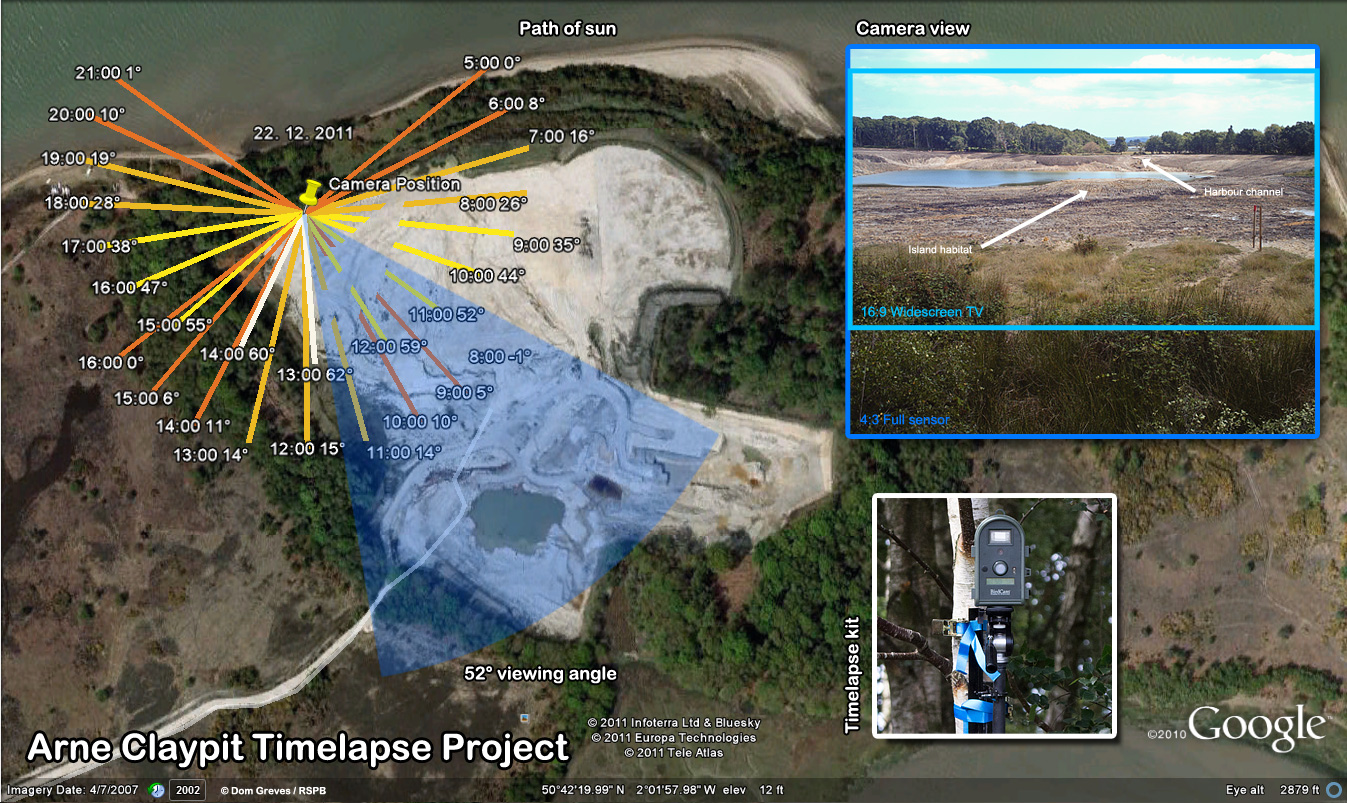
We surveyed the best location for the camera – somewhere with a wide view of the pit, a glimpse of the harbour in the background, a small island in the middle ground and some vegetation in the foreground to provide varied visual interest.
Unfortunately this necessitated pointing the camera due south, so we also calculated the position and angle of the sun in future months to try to minimise its dazzling effect on the camera’s lens and sensor.
Arne claypit timelapse project plan
The pit itself is off-limits, but there is public access to the surrounding area and it is too remote to monitor. Exposure to the elements over such a long period was also a consideration, so an expensive DSLR setup was not a practical option, and a relatively cheap-and-cheerful alternative was sourced.
The pit filled much more rapidly than the engineers had predicted and in April of the following year, after only 7 months, the rising water had achieved its final level.
The following video sequence shows events over that period, compressed to just 1 minute, using stills taken at 3 hour intervals:
Life returns
The island habitat is already frequented by shelducks and sika deer regularly visit its shores. It will take longer for the waters to settle and for other species to establish themselves.
It’s hoped that the regular interchange of water with the harbour will prevent the process of eutrophication, which would otherwise make the lagoon inhospitable. The suspension of clay particles in the water can be a serious problem in this respect.
Arne claypit reclamation stills sequence
Whether this industrially exploited area becomes the wildlife oasis hoped for only time will tell.
With thanks to Mark, Rob, Damon, James and Em at RSPB Arne.
In the scorchingly hot, dry month of June 2011, Upton Heath near Poole in Dorset caught fire. I happened to be on the Arne peninsula at the time, and recorded this video footage from the opposite side of Poole Harbour:
Fanned by strong winds, the fire spread rapidly to become the largest heathland blaze in Dorset for decades.
Upton Heath was home to some of the UK’s rarest wild creatures, including the smooth snake, sand lizard and dartford warbler.
Over the following few days I documented the aftermath of the fire for the RSPB and Natural England, with permission of the Dorset Wildlife Trust’s team on-site:
Symbol of the RSPB in the UK, the avocet was extinct as a breeding species by the mid 19th century, only returning to these shores during the second world war after the flooding of East Anglian marshes for coastal defence restored ideal wetland territory for the birds. Since then the reintroduction and careful managment of this scarce habitat elsewhere in the UK has proved to be a major conservation success story.
Hundreds of avocets overwinter on the south coast of England in Poole Harbour – the second-largest natural harbour in the world. In autumn they can often be found huddled together in the lagoon on Brownsea Island close to the busy shipping lanes at the harbour entrance. As winter draws on the birds seem to disperse, favouring the more sheltered harbour channels. The Middlebere channel to the south of the Arne peninsula is a particularly popular location.
Avocets gather in Poole Harbour
My main goal on this day was to film and photograph some winter finches along the crop trail managed by the RSPB’s wardens on the Arne Reserve. However it quickly became overcast and I wandered off in the direction of Coombe Heath to see what wading birds were on the Middlebere channel instead. By the time I reached the viewing screens the clouds had cleared and a ‘raft’ of several hundred avocets was beautifully lit in the low winter sun:
Raft of avocets on the Middlebere channel from Arne
Unfortunately the birds moved off before I could set up my tripod for video but one of the RSPB’s wardens kindly pointed out a sheltered spot near the shore where I could get a closer view of their new location.
As I sat and watched the light on the harbour just got better and better with each passing minute. The calls of the waders could be clearly heard in the still air and, as the tide turned, the raft of birds gradually dispersed in my direction, scouring the mud for tasty morsels:
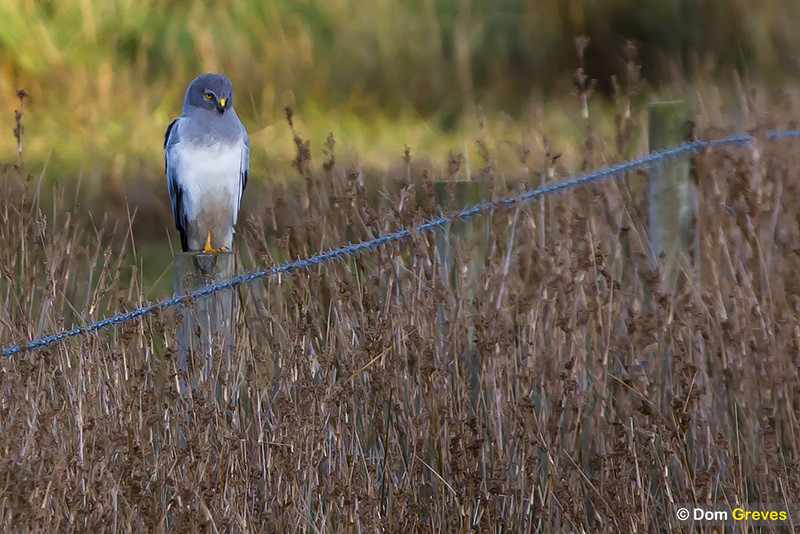
We’re lucky to have at least two male hen harriers overwintering on the shores of Poole Harbour this year. They’re visually quite distinct from the female hen harrier and other local raptors like the buzzard and marsh harrier. From a distance they might be mistaken for a gull as they patrol above the reed beds.
On this particular afternoon I’d been sat in a freezing hide at Middlebere overlooking a channel off the harbour with several other people. The male hen harrier passed the hide on 2 occasions as it hunted, and we were well pleased.
As the light began to fade and the temperature dropped so my companions began to leave. As dusk approached it was just me and my camera when this fella chose to alight on the neighbouring fenceline:
I couldn’t quite believe my luck. It was clearly aware of my presence but seemed entirely unbothered. The bird continued to survey the reeds from its vantage point for some minutes. I hurriedly assembled my tripod and mounted the camera to switch to video mode. At which point this happened:
The harrier clearly spotted something edible in the reeds and swooped in to grab it. Either it missed, or the prey got away at the first attempt, but the harrier did not give up and flapped around after it in the reeds.
Seeing this grounded raptor the local fox recognised a golden opportunity and rushed in while its back was turned. Foxy must have come within a couple of feet of success. In the slow motion sequence you can see the harrier attempt to lift off, with the prey in its grasp, but gets snagged on the reeds with almost fatal delay. What appears to be a small mammal, probably a vole, then falls from its clutches as it finally gets airborne.
The slightly dejected, but still rather smug looking fox, then sauntered off right past the hide:










 Dom Greves Digital / Blog