Meet our amazing mygalomorph, discover its life cycle and learn how to find it
The scarce Purse Web Spider (Atypus affinis) is rarely seen because it spends the majority of its life underground in a sock-shaped tube. In the UK it has the honour of being our only member of the mygalomorph family, which elsewhere includes tarantulas.
Male Purse Web Spider (Atypus affinis) on heathland. Dorset, UK.
Purse Web Spiders normally lead a solitary existence in a silk-lined burrow. The top portion of this tube extends above ground and is extremely well camouflaged with its surroundings, covered with bits of vegetation and debris. Most of the time this tube is completely sealed.
Camouflaged web of Purse Web Spider (Atypus affinis) on heathland. Surrey, UK.Female Purse Web Spider (Atypus affinis) female in tube web. Sussex, UK.Female Purse Web Spider (Atypus affinis) female in tube web. Sussex, UK.
When the Purse Web Spider’s prey makes contact with the exposed section of burrow the spider senses its vibrations and bites through the silk with its huge fangs. These distinctive downward-facing ‘chelicerae’ are shared with its larger, more exotic, arachnid ancestors. The fangs of more modern spiders cross over.
Male Purse Web Spider (Atypus affinis) on heathland. Dorset, UK.
In spring and autumn each year male Purse Web Spiders leave their burrows to go wandering in search of females. This is when you are most likely to find an adult spider. If successful in his quest he tears an entrance in her silk tube and, after mating, the pair will live here together for a while.
In early spring each year juvenile Purse Web Spiders exit the nest burrow and climb surrounding vegetation. They weave thick lines of silk to aid dispersal, and build tent-like structures around which they initially congregate.
Purse Web spiderlings (Atypus affinis) dispersing. Surrey, UK.Purse Web spiderlings (Atypus affinis) create silk rigging. Surrey, UK.
Locating this silk rigging is a good indication that an adult’s burrow is nearby. Look out for it at the top of low gorse or heather on heathland in the south of England from mid-March. This species can also be found on chalk grassland.
Silk tents constructed by Purse Web spiderlings (Atypus affinis) on heathland. Surrey, UK.
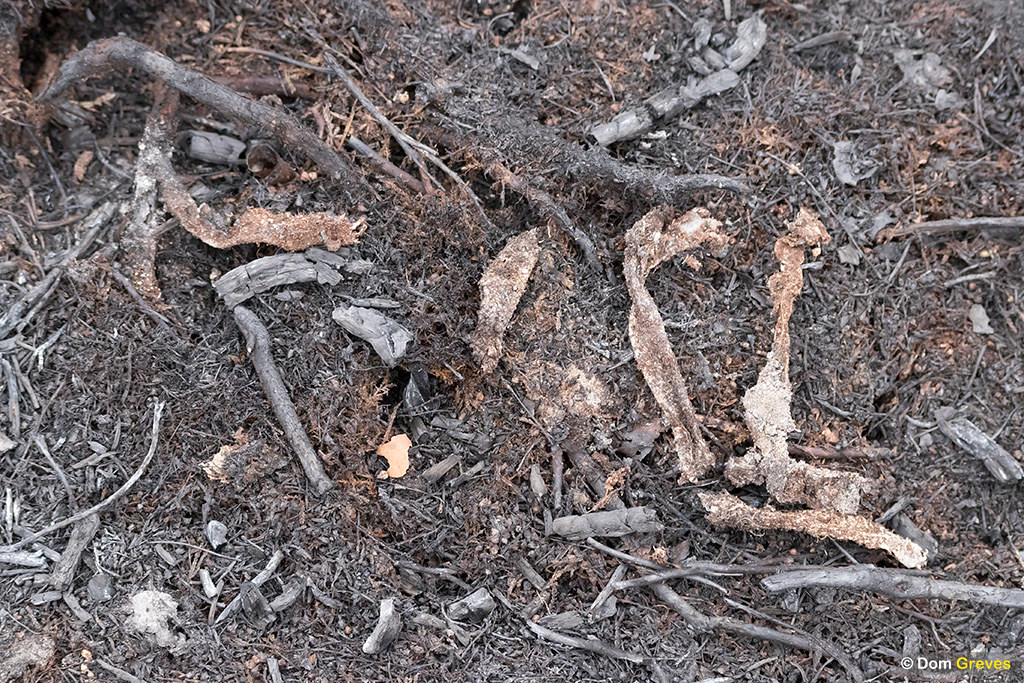
In the aftermath of heath fires, discarded sections of Purse Web tubes become more visible. Heat damages the surface layer of camouflage, exposing brighter silk beneath.
Discarded Purse Web Spider (Atypus affinis) tube webs on burnt heathland. Surrey, UK.Discarded Purse Web Spider (Atypus affinis) tube webs recovered from burnt heathland. Surrey, UK.
The Purse Web Spider is classified as Nationally Scarce and is Amber Listed. Although it remains widespread, the species has undergone substantial decline. However there is limited data available and so the British Arachnological Society (BAS) has launched a new Purse Web Spider Recording Scheme using iRecord. If you find one of these amazing creatures please be sure to let them know!
One very soggy White Admiral caterpillar this evening, draped across his former hibernaculum. There were streams in the wood where I haven't seen water before. 🦋🐛⛈️ #WhiteAdmiralWatchpic.twitter.com/LDmxvXKG7S
The reason for Rollo’s delayed development becomes clear…
A fly was over-eager to pay its last respects to my parasitised White Admiral caterpillar. But even in this near-fatal condition Rollo summoned the energy to lash out with his head! #WhiteAdmiralWatchpic.twitter.com/RgCOWbHhxg
White Admiral butterfly metamorphosis: from larva to prepupa to pupa to imago.
In Sussex during the COVID-19 epidemic of 2020 I followed one very special butterfly through pupation to emergence
The White Admiral (Limenitis camilla) is a large woodland butterfly which glides effortlessly along forest rides. Its numbers in the UK have rebounded since the First World War, possibly due to the cessation of coppicing which, unusually, has benefited this species since its larvae require Honeysuckle growing in shady woodland.
28 May
My first, long awaited, encounter with ‘Camilla’ came on 28 May when my many searches of Honeysuckle vines finally bore fruit and this magnificent creature suddenly greeted me.
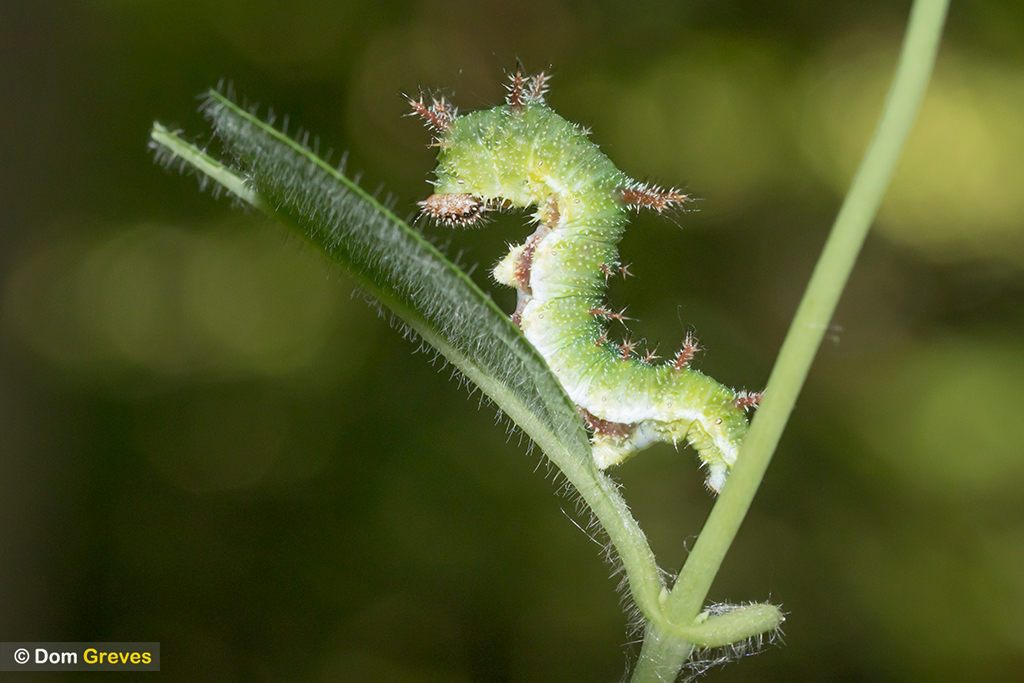
White Admiral (Limenitis camilla) 5th instar caterpillar on honeysuckle (Lonicera periclymenum).
White Admiral caterpillars are entirely dependent on Honeysuckle for their survival, feeding on its leaves through all five larval instars and hibernating within their folds.
At more than 2 cm in length this was a fifth and final stage caterpillar, exotic in appearance compared to the majority of British butterfly larvae, adorned with branching red spines along its back and resting in a raised serpentine position.
31 May
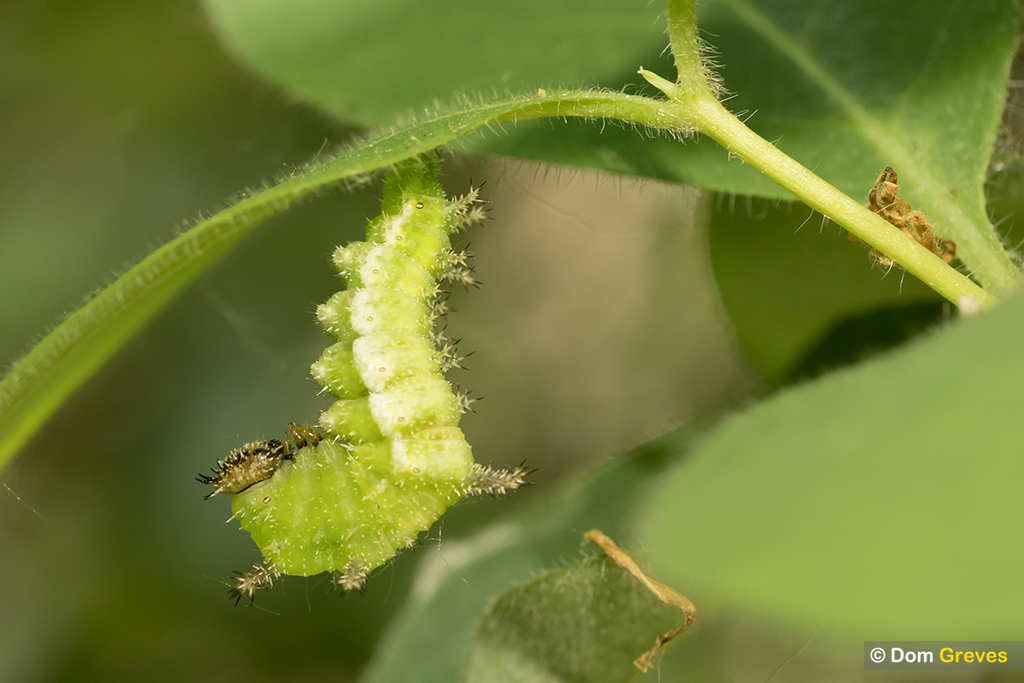
When I returned 3 days later Camilla was already preparing to pupate, hanging beneath a Honeysuckle leaf, suspended from her hind claspers attached to a pad of silk.
White admiral (Limenitis camilla) prepupa suspended from honeysuckle (Lonicera periclymenum).
2 June
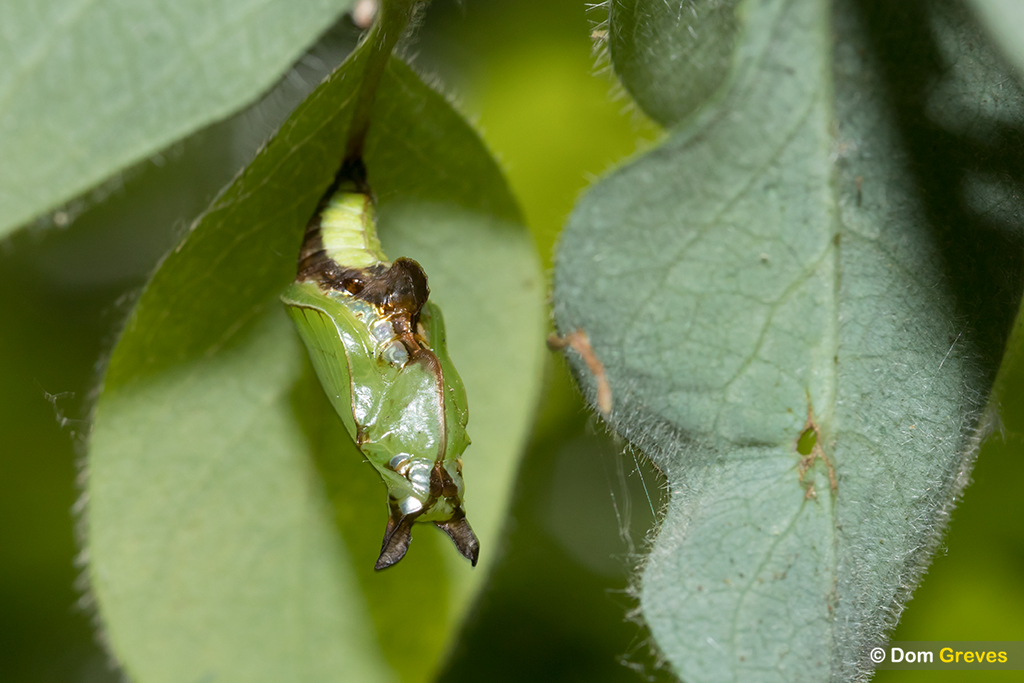
48 hours later the pupa was now fully formed, with two prominent horns on the head and an odd protrusion further back.
“The pupa bears a close resemblance to a profile portrait of Punch.”
– Frohawk (1924)
White admiral (Limenitis camilla) pupa suspended from honeysuckle (Lonicera periclymenum). Day 1.
7 June
The pupa darkened up a little in the next few days, its undulations mimicking the Honeysuckle leaves quite convincingly.
White admiral (Limenitis camilla) pupa suspended from honeysuckle (Lonicera periclymenum). Day 6.
For the next two weeks few visible changes occurred and the weather turned cold and wet. A marauding army of small birds came and went, leaving Camilla thankfully undisturbed.
23 June
Around Day 22 the folded wing veins became a bit more pronounced beneath the pupal case and its body seemed to have plumped up a bit. Warm, sunny weather had returned to the woodland glade.
White admiral (Limenitis camilla) pupa suspended from honeysuckle (Lonicera periclymenum). Day 22.
24 June
Revisiting on the morning of Day 23 I found Camilla had darkened up overnight, turning from green to brown, signalling that ‘eclosion’ of the adult butterfly was imminent.
White admiral (Limenitis camilla) pupa suspended from honeysuckle (Lonicera periclymenum). Day 23 (AM).
By 5pm that afternoon my ‘White’ Admiral was now distinctly black!
White admiral (Limenitis camilla) pupa suspended from honeysuckle (Lonicera periclymenum). Day 23 (PM).
From a different angle the butterfly’s wing structure and patternation could clearly be seen.
“Before emergence it turns to a bronze-black all over, losing almost all the metallic lustre of silver-gilt; the white wing markings of the imago show pale amber colour through the pupal skin.”
– Frohawk (1924)
White admiral (Limenitis camilla) pupa suspended from honeysuckle (Lonicera periclymenum). Day 23 (PM).
I was hopeful the adult butterfly would emerge that evening and so remained until well after dusk, but as it grew dark I was forced to return home for the night.
25 June
Back on site very early next morning I was relieved to discover that the big moment had yet to arrive.
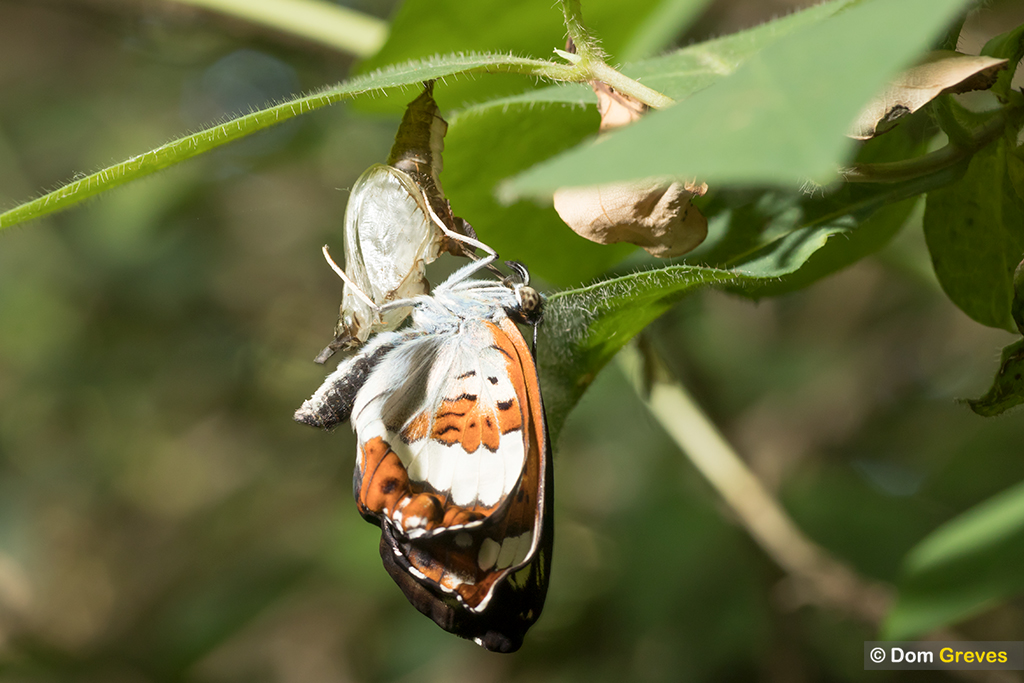
Camilla remained suspended from the Honeysuckle leaf until 09:11 on Day 24 when she suddenly popped out of her chrysalis in the blink of an eye, annoyingly while my back was briefly turned!
White admiral (Limenitis camilla) imago newly hatched. Day 24.
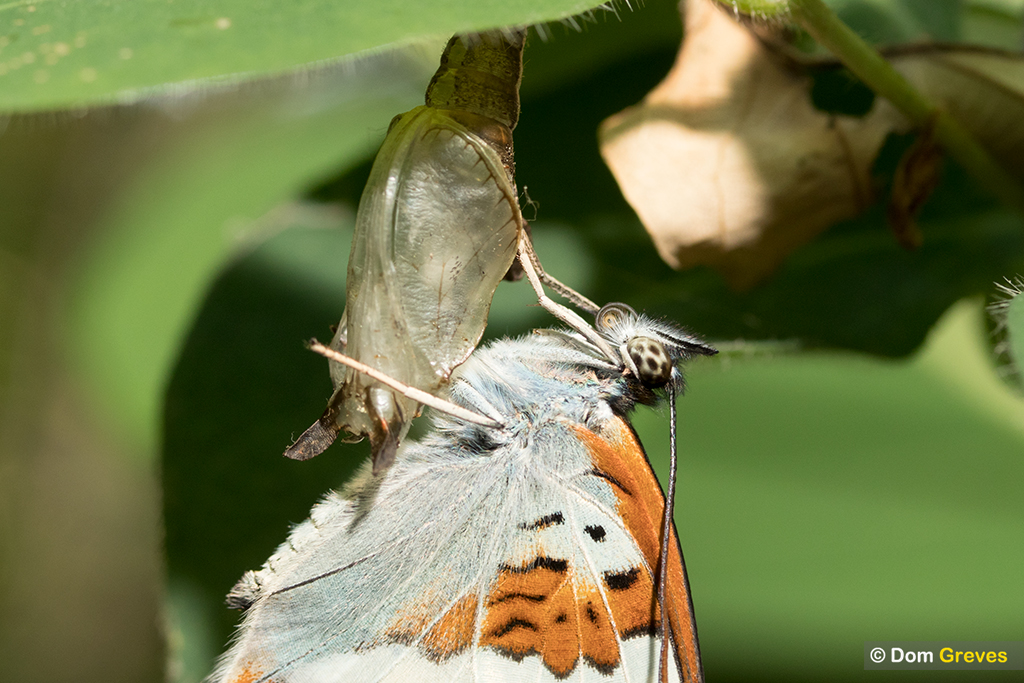
Camilla luxuriated in the warm morning sunlight streaming through the oak canopy, slowly expanding her glorious wings as she clung to the vacant ‘exuvia’.
White admiral (Limenitis camilla) imago newly hatched. Day 24.
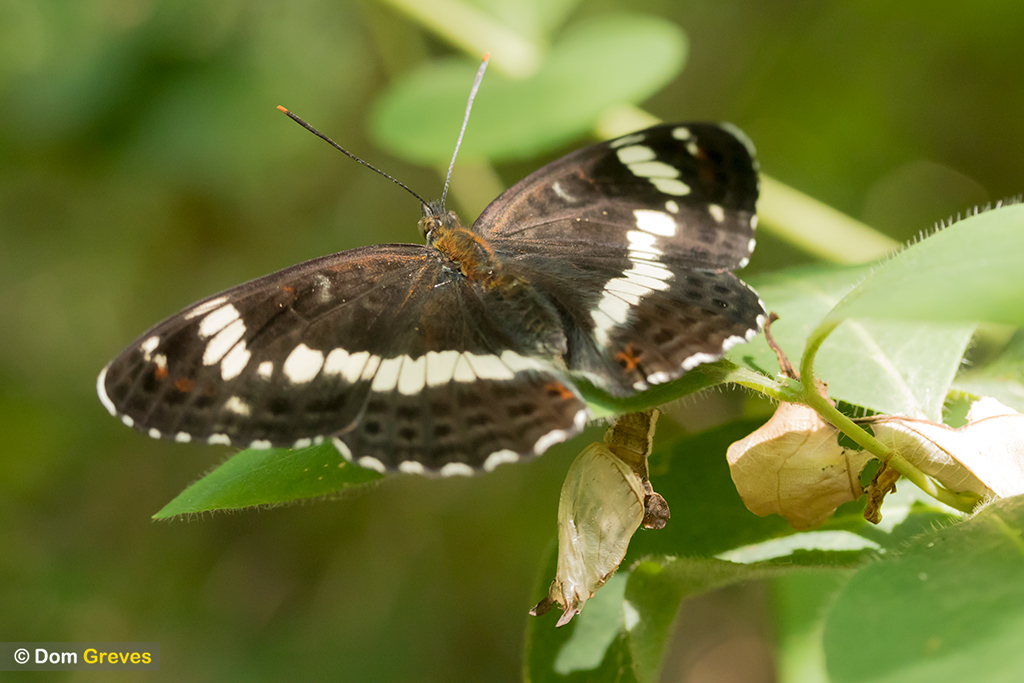
By 10:50 her wings were fully expanded and at 11:12, two hours after emergence, she clambered nimbly up onto the Honeysuckle leaf which had supported her pupa through sun and rain, heat and cold, for the past 24 days. It would now become her launching pad.
White admiral (Limenitis camilla) imago shortly before first flight.
And then 8 minutes later, at 11:20 she flew for the first time… and was gone!
Video showing newly emerged White Admiral (Limenitis camilla) butterfly drying its wings before takeoff.
Except that I strongly suspect she hung around…
I only witnessed one other adult White Admiral in the wood that summer. The individual photographed below frequented Bramble blossom within metres of Camilla’s hatching site, sunning itself on the woodland floor nearby and alighting on Honeysuckle, likely assessing suitable spots to lay her eggs for the next generation of White Admiral caterpillars to emerge.
White admiral (Limenitis camilla) butterfly nectaring on bramble flowers.
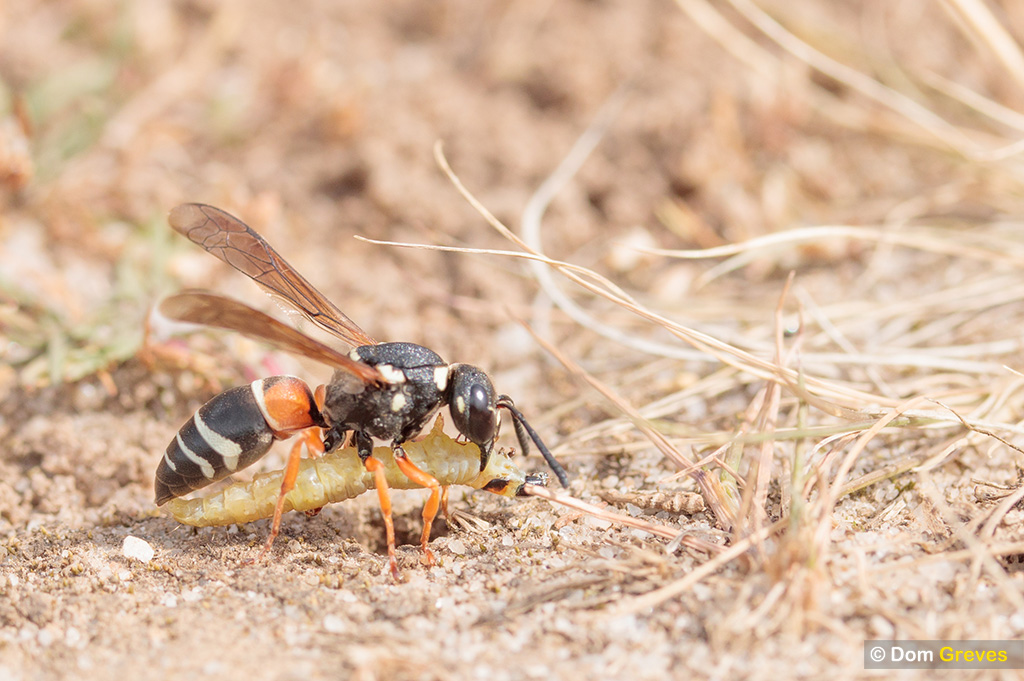
In the UK the rare Purbeck mason wasp (Pseudepipona herrichii) is found only in the Isle of Purbeck, Dorset.
The female excavates a nest burrow in bare ground on heathland and later seals it with moistened clay.
Purbeck mason wasp (Pseudepipona herrichii) excavating nest burrow on heathland. Dorset, UK.
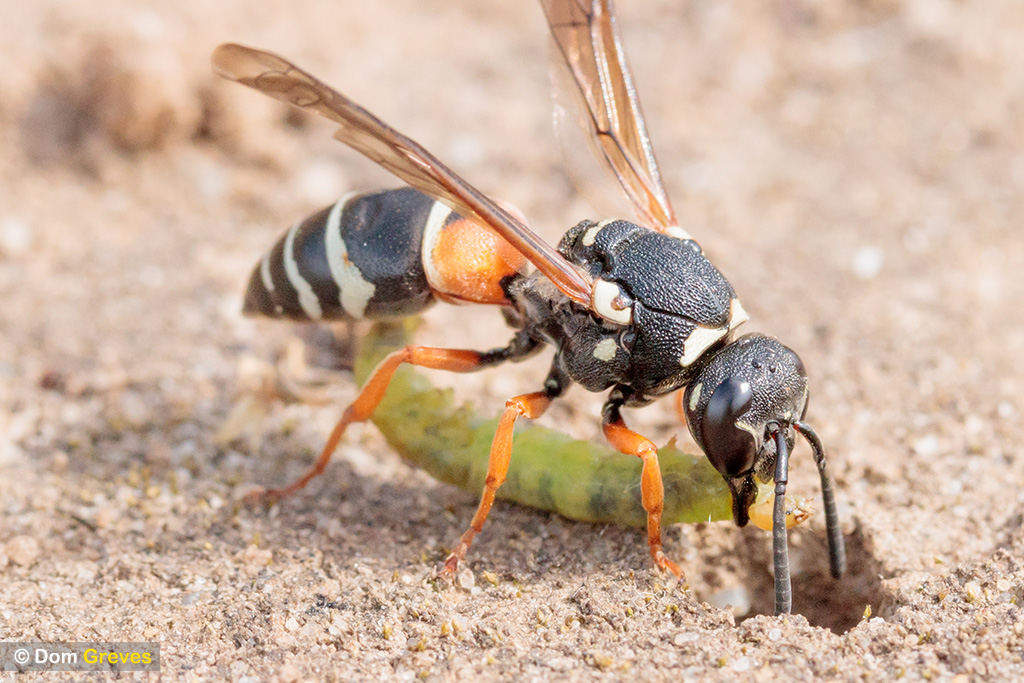
She stocks her burrow with the larvae of a small moth which feeds mainly on bell heather.
Purbeck mason wasp (Pseudepipona herrichii) with Acleris hyemana moth larva prey at nest burrow entrance. Dorset, UK.
The adults chew distinctive holes in the heather flowers to obtain nectar which their short tongues could not otherwise reach.
Purbeck mason wasp male nectaring on bell heather. Dorset, UK.
The Purbeck mason wasp is thought to rely solely on the larvae of Acleris hyemna, but in 2017 I photographed this female provisioning her nest with what appears to be the moth Acleris notana.
Purbeck mason wasp (Pseudepipona herrichii) with moth larva prey (Acleris notana?) at nest burrow entrance. Dorset, UK.
The fly orchid (Ophrys insectifera) is usually found on chalk and limestone soils in open deciduous woodland and scrub, but is also recorded from grassland and chalk-pits. It is rare in the UK and even at known locations can be difficult to spot.
Fly orchids in woodland clearing. Surrey, UK.
Fly orchids are in flower between May and June. At this time they attract male digger wasps (Argogorytes mystaceus) with a scent which closely resembles the female wasp’s pheromone.
Males attempt to copulate with the orchid and during this process pollinia become attached, which may be carried to the stigma of another flower, completing pollination.
Male digger wasp (Argogorytes sp.) pseudocopulating with fly orchid (Ophrys insectifera).Fly orchid pollinia attached to the head of male digger wasp.
I was finally lucky enough to observe and document this behaviour in the Surrey Hills earlier this year.
After emerging from hibernation in early spring, toads migrate back to their breeding ponds.
Males fight to secure mates and often outnumber the females at some sites. When this happens the female may be grasped by several males in a position known as ‘amplexus’, as they compete to be in the best position to fertilise her eggs.
Group of toads in amplexusSpawning might look fun but can also be life-threatening!Toad sex is apparently a moveable feast!
The common toad is widespread in Surrey, however populations appear to be declining. Where toad migration routes cross busy roads there can be many fatalities, and local conservation groups police ‘Toad Crossings’ at dusk to help them safely across.
The wood ant mounds among the pine trees were beginning to stir on my visit to the RSPB’s Arne reserve in Dorset recently.
Nests become active in early spring when worker ants begin to forage for food items and building materials to repair damage sustained over the winter months. Badgers, magpies, jays and other animals often raid wood ant nests for food.
Wood ants are capable of carrying relatively heavy loads
Wood ant colonies can contain up to half a million individuals. On sunny days worker ants ‘sunbathe’ at the nest entrance to absorb heat and then re-enter the nest to release it – keeping it at a steady temperature. When the nest becomes too warm they open small vents to cool it down.
Sunbathing worker ants at nest entrance
The ants are particularly aggressive in springtime as they re-define their territories. Sometimes ants from weaker neighbouring colonies are recruited by force and carried back to the main colony.
Worker ant carrying another wood ant between nests
This species of wood ant is classified as Near Threatened (NT) in the IUCN Red List and classified in Great Britain as Local. Numbers seem to be increasing in the south of England but it has become locally extinct in parts of its former range in the north and east of England, the Midlands and north Wales.
Photographing ants is always a challenge because they’re small and they move very fast. It’s a good idea to keep your trousers tucked firmly into your socks when lying on the ground this close to a nest full of them! They will bite occasionally but can’t pierce skin. The formic acid they squirt in defence is too weak to harm humans.
Unsurprisingly the report concludes that UK moth numbers are in decline, documenting a 40% drop in total abundance in the south of England over the last 40 years.
On the bright side many more moth species have colonised Britain in recent decades than have become extinct.
This photograph was taken at a recent moth trapping event on Chatley Heath organised by Surrey Wildlife Trust. The original image below:
The Crouch Oak once marked the perimeter of Windsor Great Park and is thought to date from the 11th Century, making it in excess of 900 years old.
This ancient tree now looks a little incongruous as a modern residential estate has grown up around it.
The Crouch Oak at night with passing traffic
It’s interesting to compare depictions of this tree from the 19th Century and in 1904 as wooden fences are replaced with metal railings and a dusty track becomes a surfaced road. The oak also enjoyed an additional limb in those days.
In more recent times the Crouch Oak survived an arson attempt in 2007 and is now fitted with metal grilles across its hollow openings to prevent a repeat.
Metal grille stops burning objects being thrown inside
To see the Crouch Oak for yourself follow the map below to the bend in Crouch Oak Lane:
You’d think that arachnids and water was an unhappy combination, but one species of European spider has made boggy ponds their home.
The raft spider (Dolomedes fimbriatus) is the UK’s largest native spider – its body growing up to 2cm long.
It uses the water’s surface like other spiders use their webs – feeling for the vibrations of potential prey with front legs extended. Using this technique it hunts tadpoles, insects and occasionally small fish:
Raft spider eating damselfly
When alarmed, the water repellent hairs on the raft spider’s legs enable it to dive beneath the water, trapping a bubble of air to keep it alive until the coast is clear and it cautiously re-emerges:
The wetland pools favoured by raft spiders are increasingly rare in this country. On the RSPB’s Arne reserve in Dorset their habitat is lovingly preserved, and offers wildlife watchers easy access from the nearby heathland trail:
Boggy pond habitat
On a good day dozens of raft spiders at various stages in their life cycle can be witnessed at the pond’s edge.
1. Sex
The female raft spider is often considerably larger than the male and mating is a dangerous business. He approaches her cautiously, waving his front legs tentatively to judge her receptiveness:
Male raft spider approaches female at her den
She may rush out to scare him off on numerous occasions, after which she retreats and the process begins again, the male edging closer all the while. It’s a nerve jangling thing to watch, let alone participate in.
2. Birth
The female spins a silk bag to contain the fertilised eggs, which she carries about beneath her body, keeping it just warm and moist enough to ensure their survival:
Raft spider carrying egg sac
Then, when the baby spiders are ready to hatch, she lashes the egg sac to vegetation at the edge of the pond and the tiny hatchlings emerge:
Baby raft spiders in nursery web
Mum typically lies in wait nearby to ensure that her young ones don’t come to any harm:
Raft spider guards her hatchlings
This phenomenon of hundreds of spiderlings crowded together for their own mutual safety is only really appreciated up close:
Raft spider hatchlings closeup
But soon the young raft spiders are large enough to fend for themselves and disperse around the pond.
3. Death
Raft spiders are not fussy eaters. When times are tough and food is scarce, or when too many raft spiders compete for the same local resources, they may even turn to cannibalism:













 Dom Greves Digital / Blog