Purse Web Spider: Britain’s Tarantula

Meet our amazing mygalomorph, discover its life cycle and learn how to find it

The scarce Purse Web Spider (Atypus affinis) is rarely seen because it spends the majority of its life underground in a sock-shaped tube. In the UK it has the honour of being our only member of the mygalomorph family, which elsewhere includes tarantulas.

Male Purse Web Spider (Atypus affinis) on heathland. Dorset, UK.

Purse Web Spiders normally lead a solitary existence in a silk-lined burrow. The top portion of this tube extends above ground and is extremely well camouflaged with its surroundings, covered with bits of vegetation and debris. Most of the time this tube is completely sealed.

Camouflaged web of Purse Web Spider (Atypus affinis) on heathland. Surrey, UK.
Female Purse Web Spider (Atypus affinis) female in tube web. Sussex, UK.

When the Purse Web Spider’s prey makes contact with the exposed section of burrow the spider senses its vibrations and bites through the silk with its huge fangs. These distinctive downward-facing ‘chelicerae’ are shared with its larger, more exotic, arachnid ancestors. The fangs of more modern spiders cross over.

Male Purse Web Spider (Atypus affinis) on heathland. Dorset, UK.

In spring and autumn each year male Purse Web Spiders leave their burrows to go wandering in search of females. This is when you are most likely to find an adult spider. If successful in his quest he tears an entrance in her silk tube and, after mating, the pair will live here together for a while.

In early spring each year juvenile Purse Web Spiders exit the nest burrow and climb surrounding vegetation. They weave thick lines of silk to aid dispersal, and build tent-like structures around which they initially congregate.

Purse Web spiderlings (Atypus affinis) dispersing. Surrey, UK.
Purse Web spiderlings (Atypus affinis) create silk rigging. Surrey, UK.

Locating this silk rigging is a good indication that an adult’s burrow is nearby. Look out for it at the top of low gorse or heather on heathland in the south of England from mid-March. This species can also be found on chalk grassland.

Silk tents constructed by Purse Web spiderlings (Atypus affinis) on heathland. Surrey, UK.

In the aftermath of heath fires, discarded sections of Purse Web tubes become more visible. Heat damages the surface layer of camouflage, exposing brighter silk beneath.
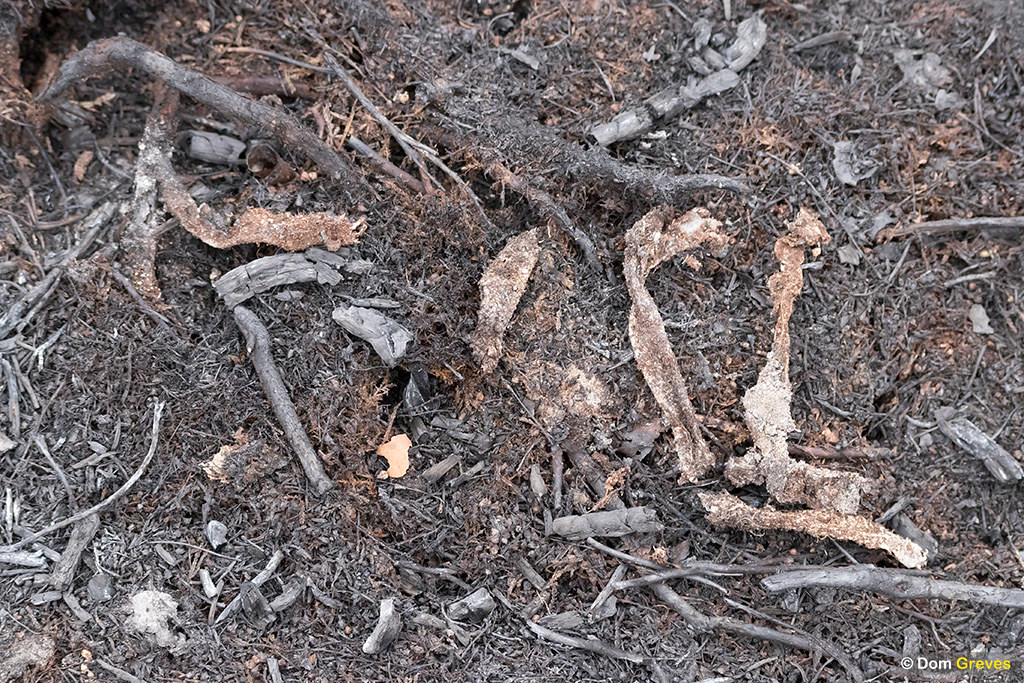
Discarded Purse Web Spider (Atypus affinis) tube webs on burnt heathland. Surrey, UK.
Discarded Purse Web Spider (Atypus affinis) tube webs recovered from burnt heathland. Surrey, UK.

The Purse Web Spider is classified as Nationally Scarce and is Amber Listed. Although it remains widespread, the species has undergone substantial decline. However there is limited data available and so the British Arachnological Society (BAS) has launched a new Purse Web Spider Recording Scheme using iRecord. If you find one of these amazing creatures please be sure to let them know!

Find out more

Aerial Imaging

Cost-effective environmental imaging services combining camera drone and cloud technology

As a drone pilot and operator registered with the Civil Aviation Authority (CAA) in the UK I’m able to offer a variety of commercial services in open countryside locations.

Mapping

On one privately owned site in the Surrey Hills AONB I mapped 32 hectares (79 acres) of part ancient, mixed broadleaf woodland.

Thousands of individual images were stitched together to create an orthomosaic, which was then exported as individual GeoTIFF tiles compatible with GIS software. Very high resolution single images can also be generated (2cm/pixel).

Mapping missions were flown at different times of year to observe seasonal variation.

Analysis

Spectral analysis techniques allow aerial imagery to be used for environmental monitoring at landscape scale. The image below compares visual spectrum vs. enhanced NDVI processing to study plant health.

Visual spectrum vs. NDVI showing replanted woodland

Change detection

Orthomosaic images facilitate accurate measurement to inform effective land management. The aerial map below quickly measured the extent of a heathland fire at Thursley Common NNR in Surrey for Natural England.

Aerial drone map showing extent of Thursley NNR heath fire

Monitoring

Below is an aerial survey of a Homes England residential development at the point where a new access road crosses a river valley intended to form a ‘green corridor’ for wildlife. Orthomosaic, NDVI and elevation visualisations are compared.

This short animation shows the image resolution (~2cm/pixel) attained from the same drone survey mission flown at an altitude of 100m.

Timelapse

By layering orthomosaic images created in different seasons it’s possible to create a wide area timelapse sequence, as shown below.

Drone vs. satellite

Drones and satellites offer complementary technologies for aerial imaging, but camera drones enjoy a few advantages:

  1. Resolution
    Satellites cannot compete with drones for detail. Satellite images will allow you to see individual trees, but with a drone it’s possible to distinguish each leaf.
  2. Perspective
    Satellites are restricted to flat overhead perspectives. A well-operated drone can film or photograph any subject from almost any angle. This can assist in the capture of digital elevation models using 3D point clouds.
  3. Urgency
    You don’t need to wait for cloud cover to clear before flying a drone survey! If clouds obscure your satellite image you have no option but to schedule another attempt… and cross your fingers.

White Admiral Watch: Rollo’s Story

A tale in tweets following the life of Rollo, a White Admiral butterfly caterpillar, offspring of Camilla…

As Rollo slumbers a brief interlude follows…

https://twitter.com/domgreves/status/1308780313020170242

We return to the star of our show…

Rollo’s close neighbour catches a chill…

Spring returns to the wood…

White Admiral Watch pays tribute to Eric Carle, author of ‘The Very Hungry Caterpillar’…

But not all is well…

The reason for Rollo’s delayed development becomes clear…

Search #WhiteAdmiralWatch on Twitter for more!