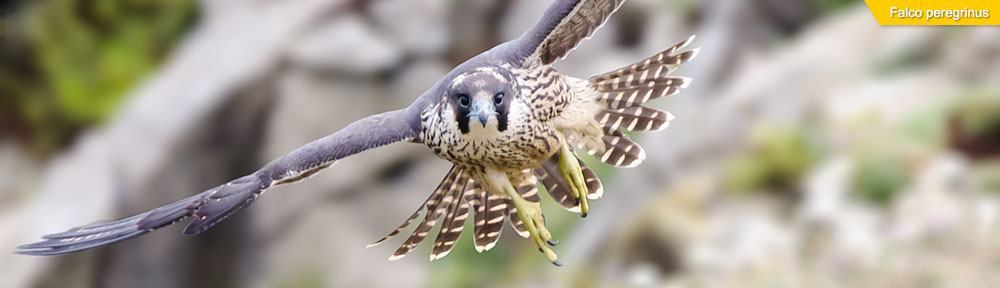
I was delighted to be voted Winner in the Spring / Summer 2011 ‘Images of Durlston’ photo competition earlier this month, with this image of a juvenile peregrine patrolling the clifftops:
Juvenile peregrine in flight on clifftops
Durlston Country Park and Nature Reserve is located on the south coast of Dorset just outside Swanage.
I was fortunate enough to be a regular volunteer at Durlston for more than 2 years. This shot was taken on a brief return visit in July of this year, with a Canon EF 100-400mm lens and a bit of luck.
Two peregrines fledged in the area this year and could regularly be seen from the coast path over the summer – alternately terrorising the nesting seabirds on the cliffs below and testing their new wings in mock aerial combat with each other, and with their increasingly unamused parents.
A former boating lake beside the A3 dual-carriageway in Surrey around rush-hour is not the first place you’d go looking for hobbies in the UK. But a pair of these young raptors fledged in the area this summer on land managed by the Surrey Wildlife Trust.
I’ve had good views of hobbies in Dorset before as they pursue their favoured dragonfly food, and whilst it’s reasonably easy to capture them eating their prey mid-flight, snapping the fleeting moment in which they close in and grasp their nimble prey is another matter.
On this particular gloriously warm and sunny September afternoon I sat by the lake shore and waited as a pair of birds arrived from the neighbouring heathland and began one of many bombing runs up and down the lake in front of me.
A handful of shots managed to freeze this aerial ballet between predator and would-be prey for a moment:
This slideshow requires JavaScript.
When one of the hobbies paused from the fray in the branches of a pine overlooking the lake it was even joined by a sparrowhawk, which must have been studying its technique with some envy:
Photographic survey for RSPB and Natural England for use at public inquiry
Talbot Heath lies largely unnoticed on the outskirts of Poole in Dorset. Once it formed a seamless whole with the famous expanse of heathland familiar to Thomas Hardy and his contemporaries. Nowadays it’s sliced apart by bypass and railway to north and south, and nibbled away at by encroaching residential developments to the east and west. The sea of heathland has become an island here.
Most of the locals clearly love this precious green (and brown) open space, but its close proximity to human habitation regularly puts the heathland flora and fauna at risk from fire and other degradations. The effects of arson in particular, but also the predations of local cats, litter and path erosion present a considerable threat to this Ramsar and SSSI designated site.
Planning breach
The local borough council in their wisdom recently approved a planning application to extend a housing development in the north, onto farmland which currently serves as a buffer between urban and heathland areas. This decision was controversial for several reasons, but especially because it appeared to override a government directive which prevented new developments within 400m of heathland sites.
The RSPB and other conservation bodies became worried that this development might set a dangerous precedent and the decision eventually went to a Public Inquiry. As part of their submission to the Inquiry I was asked to document the site photographically for the RSPB and their partners at Natural England.
Urban effects
Following 3 visits to the site in late spring 2011 I delivered a library of 300+ geolocated images, documenting the Talbot Heath landscape, its flora and fauna, human visitors, and urban effects.
This slideshow requires JavaScript.
Update: In February 2012 the proposed development was refused permission by the Secretary of State for Communities and Local Government.
In the scorchingly hot, dry month of June 2011, Upton Heath near Poole in Dorset caught fire. I happened to be on the Arne peninsula at the time, and recorded this video footage from the opposite side of Poole Harbour:
Fanned by strong winds, the fire spread rapidly to become the largest heathland blaze in Dorset for decades.
Upton Heath was home to some of the UK’s rarest wild creatures, including the smooth snake, sand lizard and dartford warbler.
Over the following few days I documented the aftermath of the fire for the RSPB and Natural England, with permission of the Dorset Wildlife Trust’s team on-site:
My image of an osprey with freshly caught bass was Highly Commended in the RSPB’s Picture Arne photo competition judged by BBC TV presenter and naturalist Chris Packham:
Osprey with fish. Arne, Dorset.
The RSPB’s reserve at Arne lies on the shores of Poole Harbour in Dorset. The ospreys are regular visitors on their migration south to Africa for the winter.
I’m always interested in finding new ways to combine my photographic skills with interactive technology.
A couple of years ago I experimented with panoramic photos taken through a complete 360 degrees, stitched together, and then animated inside a Flash player to enable the user to scroll left or right and explore different aspects of the view. I incorporated these panoramas into a Google Maps interface, to provide a ‘virtual tour’ experience for the website of a local country park and nature reserve.
More recently I’ve taken this to its logical conclusion and stitched together full spherical panoramas, which not only scroll horizontally through 360 degrees, but also up to a ‘zenith’ in the sky and down to a ‘nadir’ beneath the viewer’s hypothetical feet, through 180 vertical degrees.
When viewed in a dedicated Flash or Shockwave player the effect is suitably immersive. Click the images below to be transported (requires Adobe Shockwave).
RSPB Lodmoor 360° x 180° Panorama
And this wintry scene from RSPB Arne after an unusual snowy spell:
RSPB Arne 360° x 180° Panorama
To make this exercise worthwhile you ideally want plenty of interest in the upper and lower extremities of the scene. Architectural interiors work well for this reason, as do dramatic cloudscapes.
* Shockwave wizardry courtesy of SPi-V – developed by the very talented Aldo Hoeben.
Symbol of the RSPB in the UK, the avocet was extinct as a breeding species by the mid 19th century, only returning to these shores during the second world war after the flooding of East Anglian marshes for coastal defence restored ideal wetland territory for the birds. Since then the reintroduction and careful managment of this scarce habitat elsewhere in the UK has proved to be a major conservation success story.
Hundreds of avocets overwinter on the south coast of England in Poole Harbour – the second-largest natural harbour in the world. In autumn they can often be found huddled together in the lagoon on Brownsea Island close to the busy shipping lanes at the harbour entrance. As winter draws on the birds seem to disperse, favouring the more sheltered harbour channels. The Middlebere channel to the south of the Arne peninsula is a particularly popular location.
Avocets gather in Poole Harbour
My main goal on this day was to film and photograph some winter finches along the crop trail managed by the RSPB’s wardens on the Arne Reserve. However it quickly became overcast and I wandered off in the direction of Coombe Heath to see what wading birds were on the Middlebere channel instead. By the time I reached the viewing screens the clouds had cleared and a ‘raft’ of several hundred avocets was beautifully lit in the low winter sun:
Raft of avocets on the Middlebere channel from Arne
Unfortunately the birds moved off before I could set up my tripod for video but one of the RSPB’s wardens kindly pointed out a sheltered spot near the shore where I could get a closer view of their new location.
As I sat and watched the light on the harbour just got better and better with each passing minute. The calls of the waders could be clearly heard in the still air and, as the tide turned, the raft of birds gradually dispersed in my direction, scouring the mud for tasty morsels:
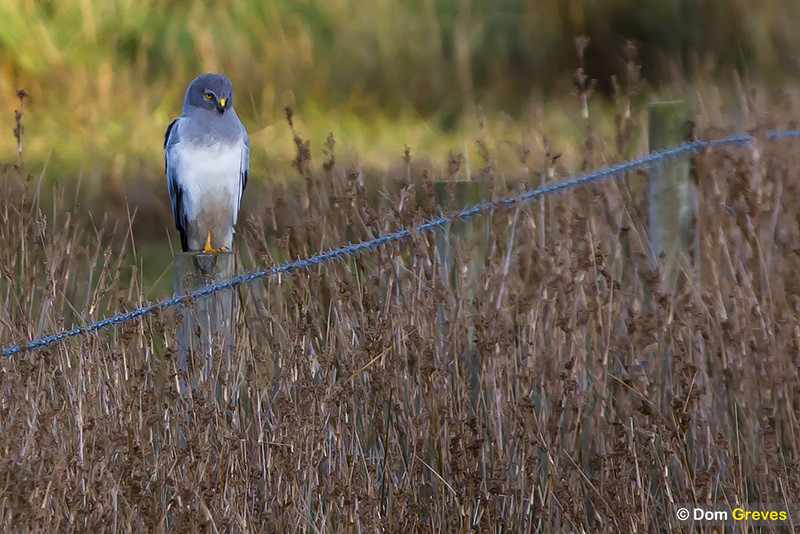
We’re lucky to have at least two male hen harriers overwintering on the shores of Poole Harbour this year. They’re visually quite distinct from the female hen harrier and other local raptors like the buzzard and marsh harrier. From a distance they might be mistaken for a gull as they patrol above the reed beds.
On this particular afternoon I’d been sat in a freezing hide at Middlebere overlooking a channel off the harbour with several other people. The male hen harrier passed the hide on 2 occasions as it hunted, and we were well pleased.
As the light began to fade and the temperature dropped so my companions began to leave. As dusk approached it was just me and my camera when this fella chose to alight on the neighbouring fenceline:
I couldn’t quite believe my luck. It was clearly aware of my presence but seemed entirely unbothered. The bird continued to survey the reeds from its vantage point for some minutes. I hurriedly assembled my tripod and mounted the camera to switch to video mode. At which point this happened:
The harrier clearly spotted something edible in the reeds and swooped in to grab it. Either it missed, or the prey got away at the first attempt, but the harrier did not give up and flapped around after it in the reeds.
Seeing this grounded raptor the local fox recognised a golden opportunity and rushed in while its back was turned. Foxy must have come within a couple of feet of success. In the slow motion sequence you can see the harrier attempt to lift off, with the prey in its grasp, but gets snagged on the reeds with almost fatal delay. What appears to be a small mammal, probably a vole, then falls from its clutches as it finally gets airborne.
The slightly dejected, but still rather smug looking fox, then sauntered off right past the hide:
Ospreys are regular visitors to Poole Harbour in the autumn, on route to Africa where they flee for the winter. These birds are especially well adapted for catching fish and extraordinary to watch.
We’re very lucky to have such magnificent neighbours but I’m not sure that many inhabitants of nearby Poole and Bournemouth realise they exist, let alone where to find them.
The National Trust have a wildlife hide at Middlebere on the edge of a channel running into the harbour. It’s tucked away in the woods opposite the RSPB’s reserve at Arne. In season the ospreys can regularly be seen commuting up and down the channel on fishing expeditions. Great to watch through binoculars and scopes, but for photographic purposes they remain a long way off.
Having watched them from the hide on a few occasions I became familiar with a regular perch nearby. It looked accessible and there was decent cover nearby, so I determined to get closer.
On more than one occasion I observed ospreys perched in the branches of a dead tree after arriving on site. However ospreys are quite happy to spend hours sat in the same location and are difficult to approach. This was the closest I managed to get with a long lens without spooking the bird:
Perched osprey (Pandion haliaetus)
To get any closer I was going to have to get into position early one morning, before the birds became active, and wait for them to come to me. Several times I hid my gear nearby, tripod-mounted camera at the ready, and waited fruitlessly for a bird to appear.
On this particular occasion I was late to arrive and could see an osprey already in position.
Osprey (Pandion haliaetus) in dead tree
Having snapped a few long distance shots I might have turned back at this point but they’re beautiful birds to watch, even at a distance.
By the time I’d crept to the next viewing position the osprey had flown, but I seized the chance to scurry into position deep in the reeds, close to the dead tree perch, and hurriedly assembled tripod, camera and improvised camouflage. Pulling the reeds back over my head I settled in for what I thought might be another long, uneventful afternoon.
But within 20 minutes I saw a large bird flying in low over the reedbed. Through the binoculars I could make out a large wriggling shape in its grasp. It could only be a returning osprey!
I ducked down out of sight and watched the perch on the camera’s LCD monitor. Nothing. Wrong branch! Swivelling the lens to the left brought this majestic osprey into focus, a freshly caught bass pinioned in its enormous talons:
Osprey (Pandion haliaetus) with freshly caught bass
Over the next hour I was privileged to watch this mighty bird devouring its meal at close quarters, and captured some memorable stills and video footage in the process:
Canon 550D | Canon EF 100-400mm f4.5-5.6 L | Adobe Premiere Pro
The reedbed was enveloped in low cloud or mist and – together with the hissing sound of the reeds in the gathering wind – the conditions heightened an already surreal, unearthly atmosphere. Something I will never forget.




 Dom Greves Digital / Blog