The RSPB’s reserve at Arne in Dorset recently requested the use of my wetland wildlife photos for their new seasonal interpretation panels. They also commissioned a stitched panoramic landscape image to highlight landmarks visible from their stunning observation point overlooking Poole Harbour.
Featured above are the Southern Hawker dragonfly, Osprey, Wasp Spider, Raft Spider and Marsh Harrier, all of which can be found on the Arne reserve at different times of the year. Well worth a visit!
You’d think that arachnids and water was an unhappy combination, but one species of European spider has made boggy ponds their home.
The raft spider (Dolomedes fimbriatus) is the UK’s largest native spider – its body growing up to 2cm long.
It uses the water’s surface like other spiders use their webs – feeling for the vibrations of potential prey with front legs extended. Using this technique it hunts tadpoles, insects and occasionally small fish:
Raft spider eating damselfly
When alarmed, the water repellent hairs on the raft spider’s legs enable it to dive beneath the water, trapping a bubble of air to keep it alive until the coast is clear and it cautiously re-emerges:
The wetland pools favoured by raft spiders are increasingly rare in this country. On the RSPB’s Arne reserve in Dorset their habitat is lovingly preserved, and offers wildlife watchers easy access from the nearby heathland trail:
Boggy pond habitat
On a good day dozens of raft spiders at various stages in their life cycle can be witnessed at the pond’s edge.
1. Sex
The female raft spider is often considerably larger than the male and mating is a dangerous business. He approaches her cautiously, waving his front legs tentatively to judge her receptiveness:
Male raft spider approaches female at her den
She may rush out to scare him off on numerous occasions, after which she retreats and the process begins again, the male edging closer all the while. It’s a nerve jangling thing to watch, let alone participate in.
2. Birth
The female spins a silk bag to contain the fertilised eggs, which she carries about beneath her body, keeping it just warm and moist enough to ensure their survival:
Raft spider carrying egg sac
Then, when the baby spiders are ready to hatch, she lashes the egg sac to vegetation at the edge of the pond and the tiny hatchlings emerge:
Baby raft spiders in nursery web
Mum typically lies in wait nearby to ensure that her young ones don’t come to any harm:
Raft spider guards her hatchlings
This phenomenon of hundreds of spiderlings crowded together for their own mutual safety is only really appreciated up close:
Raft spider hatchlings closeup
But soon the young raft spiders are large enough to fend for themselves and disperse around the pond.
3. Death
Raft spiders are not fussy eaters. When times are tough and food is scarce, or when too many raft spiders compete for the same local resources, they may even turn to cannibalism:
What kind of crazy folk go out at night and gather round bright lights in the expectation of winged visitors? Stoned party-goers after a particularly heavy session? Die-hard pagan worshippers perhaps? And moth trappers obviously.
It was my delight both to participate in and bear witness to this strange spectacle on an evening with the Surrey Wildlife Trust and assembled experts on Chatley Heath in Surrey last month. It began innocuously enough with a barbecue meal and mildly alcoholic beverage, but then the great orb in the sky descended, the darkness gathered, and things began to get weird.
Moth trappers at Chatley Tower
A white sheet stapled to the side of Chatley Semaphore Tower and illuminated with fluorescent light set the stage for our distinguished guests to arrive, and it wasn’t long before the lure of this burning beacon drew them in.
Moth trapper with net
At which point all pretence of ceremony evaporated and a man with net in hand, a wild gleam in his eye, pounced with the irresistible speed of a coiled spring released!
Once netted, the moth in question was transferred to an improvised lab bench nearby for inspection, ID and recording.
Identifying and recording moths
Steadily a queue of nocturnal visitors grew, each enclosed in a cylindrical plastic cell, and each requiring identification. A few of the larger, more striking moths, were familiar to the interested observer, but – to all except the most dedicated experts present – the majority remained strange and new.
Moth trap jars with inmates, including the yellow brimstone moth
There are roughly 800 species of ‘macro moth’ in the UK. These are the species you will find illustrated in standard field guides on the subject. But there have been 2,400 species of moth recorded in the UK when ‘micro moths’ are accounted for, and only the high priests of this cult can read the runes of their colouring and patternation with any degree of certainty.
On this particular night 73 separate species of moth were recorded – the list of outlandish guests including:
Water Veneer
Mother of Pearl
Maiden’s Blush
The Mocha
Lime-speck Pug
Coxcomb Prominent
Dark Sword Grass
Shuttle-shaped Dart
True Lovers’ Knot
Setaceous Hebrew Character
Neglected Rustic
Elsewhere on the heath nearby an even brighter beacon was being kindled: a Skinner Trap, fitted with a blinding electric bulb powered by its own noisy generator.
Skinner moth trap and trappers
Not only is this contraption very effective at attracting moths, it’s also remarkably photogenic! A portal to another world appears to have opened up on the heath at night. And for all those present at this special event, it undoubtedly had.
Light rays illuminate the heath
Nobody knows precisely why these creatures of the night are attracted to bright lights amidst the darkness, but it’s fortunate for us that they are.
Purple Emperor butterfly (Apatura iris) feasting on fresh dog turd
Such a beautiful creature with such un-photogenic habits! Infamously the Purple Emperor butterfly (Apatura iris) spurns the sweet nectar of wildflowers in favour of dog faeces amongst other delicacies.
Now mostly confined to the ancient deciduous woodlands of Surrey and Sussex in the UK, the Purple Emperor has a devoted following in the world of butterfly fans.
Normally it flies high in the woodland canopy and only occsionally will the male descend to the ground to replenish its liquids and salts in this peculiar fashion.
On these rare occasions the Emperor’s acolytes fill their boots.
Here on Bookham Common in Surrey, within sight and sound of the M25 motorway, the lack of a long lens is no handicap when this butterfly is distracted by a fresh deposit:
Purple Emperor posing for a mobile phone photograph
The less exotically coloured female at least has more refined tastes, and generally remains high in the oak trees feeding on the sticky sweet honeydew secreted by aphids. She returns a little closer to earth only to lay her eggs in a suitable sallow tree nearby.
Female Purple Emperor laying eggs on willow sapling
Such is the lure of the Purple Emperor that fanatics have been known to entice ‘His Majesty’ down from the trees with a number of foul smelling concoctions. In the absence of dung a rotting carcass may occasionally do the trick. This recently deceased rodent at a favourite butterfly haunt in the wood may have benefited from a coroner’s inquest:
If you’re looking for a photographic challenge then wildlife macro at night is guaranteed to keep you amused and frustrated in equal measure.
Glow worms (Lampyris noctiluca) come equipped with their own bioluminescent light source, and with a bit of research shouldn’t be too difficult to locate in the right environment. But in the dark simple tasks become considerably more complicated.
These ‘worms’ are in fact a beetle. On summer nights the flightless female glow worm climbs a grass stem, or other vegetation, and emits a bright chemical light from her lower abdomen. This luminous display attracts the flighted male glow worm and mating begins, at which point the happy couple turn out the light and retire to bed together in the undergrowth.
In the UK glow worm numbers – or at least the number of people reporting them – have diminished over the years. Light pollution from sprawling urban areas may be one reason for this, as the female doesn’t like competition, and seeks out the darkest rural recesses in which to display to potential mates. The inexorable rise of the motorcar has also meant fewer people traversing the countyside on foot at night, and so less likelihood of happening across these creatures. Modern use of pesticides may also have played a part.
The wilds of South Dorset proved good hunting grounds for me last year and I was keen to have another crack at this subject in Surrey over the summer.
Initial research turned up not much however. Almost every contact I quizzed looked at me with bafflement and a little wonder when I enquired about glow worms in the county, as if they’d become semi-mythical beasts in this stretch of the London commuter belt. A bit of Googling turned up a handful of vague mentions and precious few images.
The excellent UK Glow Worm Survey website, run by the extremely dedicated Mr Robin Scagell, offered more precise records and this especially tantalising glimpse of days gone by:
Box Hill, nr. Burford Bridge, Whole slope of Hill covered with glow-worms, summer 1915
Promising, but a long shot more than 90 years later perhaps. Then a chance meeting with a twitcher confirmed glow worms sighted in a very specific area of the hillside in the 1980s and the balance of probabilities swung in favour of action!
From my vantage point atop the steep chalk slope of Box Hill the sun began to set impressively, and the exhausting vertical scramble required to get there faded into memory.
Tight security in preparation for the Olympic cycle race meant that the entire National Trust property was ringed with high steel barriers. A checkpoint restricted traffic up the narrow zig-zagging road to the top, and guards with walkie-talkies patrolled its length. The pedestrian gates thankfully remained open.
Town of Dorking in Surrey from Box Hill after dark
Bright lights from the dual-carriageway below continued to illuminate the entire downland slope after the sun had faded, which wasn’t promising. But in a deep, shady dip behind the ridge a twinkling greenish light in the grasses finally caught my eye.
In total 8 glowing females were located along a short stretch of chalk track.
The first young lady was tucked well back into the shrubbery and inaccessible to my lens. The second was more exposed, on leaf litter near to the ground. With a bit of tripod gymnastics and some macro slider extension action I edged within range.
Glow Worm Filigree: Surrey glow worm on leaf litter
In this shot the natural glow from the beetle was supplemented with indirect light from an LED torch off to one side. It’s a balancing act to expose the whole subject without drowning out the insect’s own subtle illumination.
The same creature on a long exposure without the artifical light source gives a quite different visual impression:
Glow Worm Limelight: Glow worm (natural light)
More typically glow worms can be found in thick grass, clinging to the stems a short way up, and rotating their bottoms skyward as this next one was:
Glow Worm Jade: Glow worm in grass
Where the beetle is tightly surrounded by reflective surfaces the light she emits is magnified.
In all the above images the glow worm’s head is firmly concealed beneath her carapace, and this is usually the case I’ve found. But before I departed for the night another individual proved less coy.
Glow Worm Red Light: Glow worm under red filter LED
In these circumstances a bright white light can disturb the beetle, which then turns tail and vanishes, which is no good for observing behaviour. So I used a red filter, hoping she would be less sensitive to light in this part of the spectrum. It appeared to work and she continued to clean her antennae for some while:
Post-industrial landscape reclaimed for wetland wildlife at RSPB Arne
The Arne peninsula in Dorset juts out into Poole Harbour, separating the Wareham channel from the main body of water. Right out at the tip, concealed by the remains of ancient oak woodland, lies a former ball clay pit.
The extraction company, Imerys, finished mining the deposit in 2008. Since 2010 they have been restoring the area as part of their mitigation agreement, before transferring ownership of the site to the RSPB, who manage the surrounding nature reserve at Arne.
I was asked to document this reclamation process on behalf of the RSPB, in particular the flooding of the claypit basin with water from the harbour to create a saline lagoon habitat for wading birds and other species.
Earthworks
With mining activities ended the pit was re-profiled with heavy earth-moving equipment, and a layer of topsoil deposited above the expected final water level in the summer of 2011.
This slideshow requires JavaScript.
Next, a channel was cut through the embankment to join the claypit with the harbour at the south end of the site. On especially high tides the water from the harbour would flood this channel to gradually fill the lagoon.
This process was expected to take many months and it was decided to document the process with a timelapse camera.
View to a spill
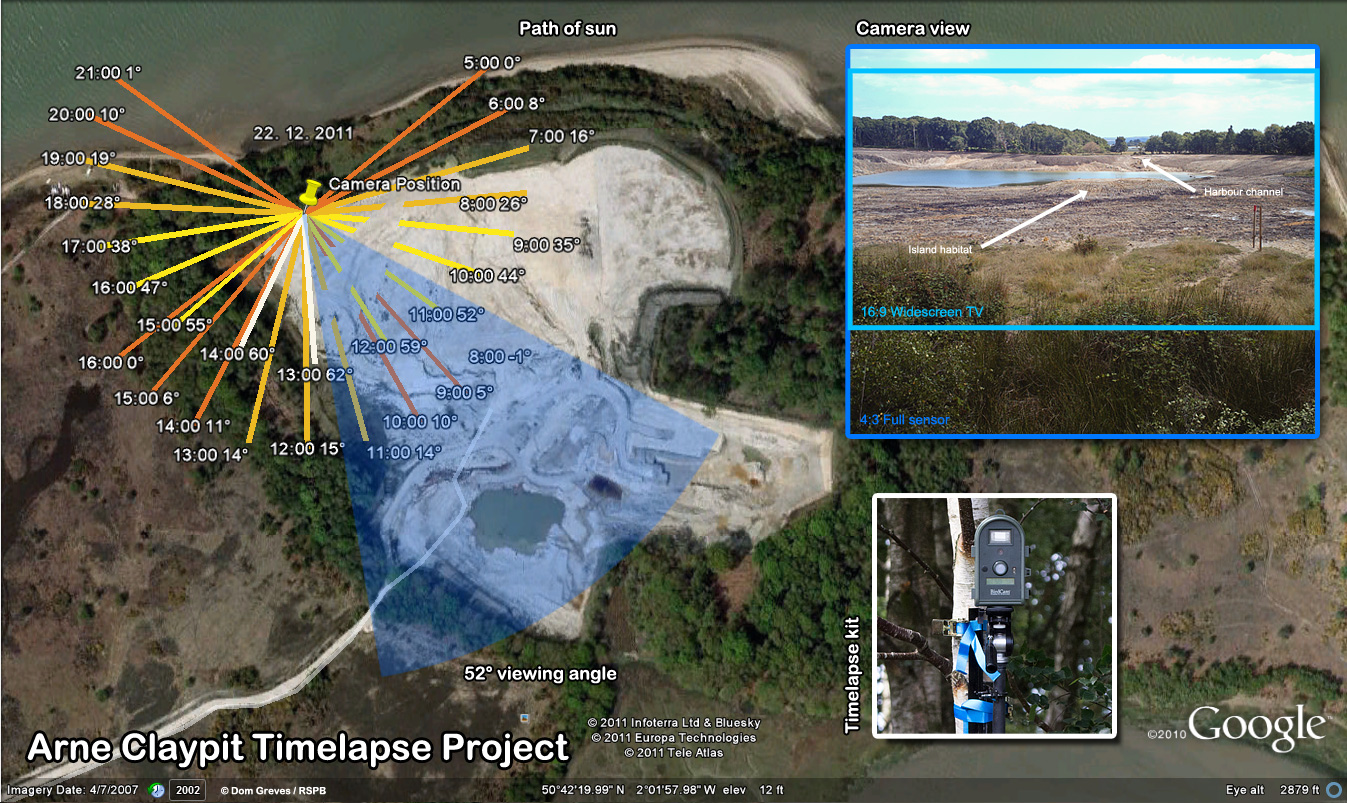
We surveyed the best location for the camera – somewhere with a wide view of the pit, a glimpse of the harbour in the background, a small island in the middle ground and some vegetation in the foreground to provide varied visual interest.
Unfortunately this necessitated pointing the camera due south, so we also calculated the position and angle of the sun in future months to try to minimise its dazzling effect on the camera’s lens and sensor.
Arne claypit timelapse project plan
The pit itself is off-limits, but there is public access to the surrounding area and it is too remote to monitor. Exposure to the elements over such a long period was also a consideration, so an expensive DSLR setup was not a practical option, and a relatively cheap-and-cheerful alternative was sourced.
The pit filled much more rapidly than the engineers had predicted and in April of the following year, after only 7 months, the rising water had achieved its final level.
The following video sequence shows events over that period, compressed to just 1 minute, using stills taken at 3 hour intervals:
Life returns
The island habitat is already frequented by shelducks and sika deer regularly visit its shores. It will take longer for the waters to settle and for other species to establish themselves.
It’s hoped that the regular interchange of water with the harbour will prevent the process of eutrophication, which would otherwise make the lagoon inhospitable. The suspension of clay particles in the water can be a serious problem in this respect.
Arne claypit reclamation stills sequence
Whether this industrially exploited area becomes the wildlife oasis hoped for only time will tell.
With thanks to Mark, Rob, Damon, James and Em at RSPB Arne.
I was exceedingly pleased to learn last week that my image of a white sika deer won the RSPB’s ‘Picture Arne’ photo competition, judged by wildlife broadcasting legend Mr Chris Packham!
Blondie
There are several white sika in the area surrounding Poole Harbour in Dorset. They are a ‘white morph’ since they don’t have the red eyes one would expect in a true albino.
Sika deer (Cervus nippon) are not native to the UK but escaped from captivity on nearby Brownsea Island some decades ago, since when they have made the Isle of Purbeck and surrounding area their home.
The RSPB’s reserve on the Arne peninsula supports a number of scarce species – most notably the dartford warbler (Sylvia undata), but also heath-loving reptiles such as the sand lizard and smooth snake.
I stumbled across this scene late one sultry August evening last year whilst returning home from another photographic project. The young sika stag was browsing in a meadow, accompanied by a small group of other more conventionally coloured deer.
One of my recent peregrine photos appears in the April 2012 edition of BBC Wildlife Magazine, illustrating an article about the remarkable international success of this species across a range of different environments – both wild and urban:
BBC Wildlife Magazine – Peregrine in Flight
My image of juvenile peregrine in flight top centre. Taken along the Dorset coast last summer.
I’m told there hasn’t been a short-eared owl seen in this part of Surrey for the last 30 years. I can’t be sure that this is true, but the presence of 3, 4 or possibly 5 individuals on the local water meadows this winter is highly unusual and they’ve become local celebrities. The human observers frequently outnumber the owls several-fold.
Short-eared owl watched by human observers
It’s been a bumper year for voles in the UK, and also lemmings in Scandinavia where our crop of over-wintering short-eared owls originate. Consequently the owl population seems to have exploded and many of them have flocked to these shores to escape the icy conditions back home.
Short-eared owl in flight
Papercourt Meadows where the owls perform each afternoon is a gloriously serene stretch of the River Wey near Ripley.
Double rainbow over Papercourt Meadow Nature Reserve
Surrey Wildlife Trust graze one of the plots for conservation and the owls appear to like what they find in the grasses.
Short-eared owl montage with prey
With any luck the shorties will be resident with us for the remainder of the winter.
The English oak (Quercus robur) provides wonderful habitat for numerous creatures, but in the (relatively mild) depths of a British winter, they keep a low profile. Wait an hour or so after dark however and the trunk of an unassuming oak tree suddenly becomes an insect super-highway.
Oak bush-cricket, harvestman and winter moths montage
A particularly interesting creature is the flightless female winter moth, which emerges from the ground and climbs the nearest trunk to liaise with the flighted male moth at altitude. She then lays her eggs high up in the canopy.
Female winter moth climbing oak tree
Male winter moth lying in wait
In a ‘good’ year hundreds of female winter moths may be seen to climb the trunk of one tree in a single night. This is not necessarily good news for the tree however, as the caterpillars rapidly denude the leaves after emerging in the spring.
Taking photos of small wild creatures in the dark presents a few challenges! To light these subjects I used an LED lamp attached to my tripod. This is a lot more predictable than using flash in inhospitable outdoor conditions, but does require a relatively long exposure time.
Many of these bugs will freeze in the bright white light required for conventional photography. This is not necessarily a bad thing for macro work, but it can alter their behaviour in an undesirable way. A young leopard slug was quickly in defensive posture for example, and remained so:
Young leopard slug
It’s also cold, dark and more than a little spooky in the woods after dusk in December, so requires several thermal layers and a degree of commitment!




 Dom Greves Digital / Blog