The hornet (Vespa crabro) is Britain’s largest wasp species.
They prey on other wasps, honey bees, flies, butterflies, moths and spiders.
Hornet disassembles solitary wasp prey
Saplings are ring-barked to encourage sap flow, which is then collected.
Hornets drinking sap from stripped birch sapling.
Nests are usually in aerial situations, particularly inside hollow trees, but also in attics and outhouses.
Hornets entering and exiting nest in trunk of hollow pine tree (composite)
Abandoned hornets’ nest in outside toilet.
Despite their fearsome reputation hornets are actually remarkably docile creatures and I found them much less intimidating to photograph than their common wasp (“yellow jacket”) relatives.
Buglife are using my image in their postcard campaign to publicise a glow worm survey in Scotland this summer:
Scottish Glow Worm Survey postcard
Glow worms are widely distributed in the UK, with records from the south of England up to the north of Scotland, but there have been very few Scottish records in recent years.
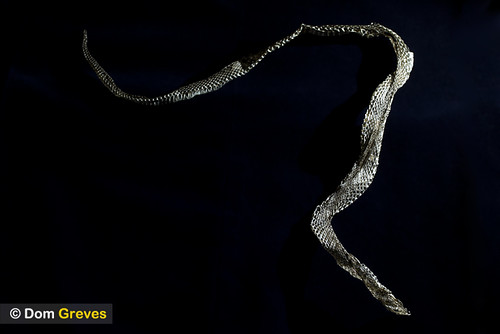
Periodically snakes and other animals shed their entire skins, in a process known as ecdysis (or sloughing, or moulting).
Moulting takes up to 14 days to complete. The inner surface of the old skin liquefies, which causes it to separate from the new skin beneath it. By rubbing its skin on hard objects the end nearest the head begins to peel back on itself, until the snake is able to crawl out of its skin, turning it inside-out like a sock.
Head end of moulted adder skin
The ocular scale, or ‘brille’, is discarded along with the rest of the skin. This is essential for maintaining the snake’s quality of vision.
Adder skin showing ocular scale detail
The visually striking process of renewal exhibited by these animals is one reason why serpents have historically been symbolic of healing and medicine in our culture.
Adder skin with side illumination
Snake skin is formed from the remarkably adaptable substance keratin. Some of its properties are best appreciated in close-up:
Backlit adder skin detail
Underside of adder skin showing transparent keratin scales
This particular skin was found on heathland, woven in amongst some dried grasses. We later stumbled across a stunning, newly sloughed, caramel-coloured female sunning herself nearby.
Unsurprisingly the report concludes that UK moth numbers are in decline, documenting a 40% drop in total abundance in the south of England over the last 40 years.
On the bright side many more moth species have colonised Britain in recent decades than have become extinct.
This photograph was taken at a recent moth trapping event on Chatley Heath organised by Surrey Wildlife Trust. The original image below:
You’d think that arachnids and water was an unhappy combination, but one species of European spider has made boggy ponds their home.
The raft spider (Dolomedes fimbriatus) is the UK’s largest native spider – its body growing up to 2cm long.
It uses the water’s surface like other spiders use their webs – feeling for the vibrations of potential prey with front legs extended. Using this technique it hunts tadpoles, insects and occasionally small fish:
Raft spider eating damselfly
When alarmed, the water repellent hairs on the raft spider’s legs enable it to dive beneath the water, trapping a bubble of air to keep it alive until the coast is clear and it cautiously re-emerges:
The wetland pools favoured by raft spiders are increasingly rare in this country. On the RSPB’s Arne reserve in Dorset their habitat is lovingly preserved, and offers wildlife watchers easy access from the nearby heathland trail:
Boggy pond habitat
On a good day dozens of raft spiders at various stages in their life cycle can be witnessed at the pond’s edge.
1. Sex
The female raft spider is often considerably larger than the male and mating is a dangerous business. He approaches her cautiously, waving his front legs tentatively to judge her receptiveness:
Male raft spider approaches female at her den
She may rush out to scare him off on numerous occasions, after which she retreats and the process begins again, the male edging closer all the while. It’s a nerve jangling thing to watch, let alone participate in.
2. Birth
The female spins a silk bag to contain the fertilised eggs, which she carries about beneath her body, keeping it just warm and moist enough to ensure their survival:
Raft spider carrying egg sac
Then, when the baby spiders are ready to hatch, she lashes the egg sac to vegetation at the edge of the pond and the tiny hatchlings emerge:
Baby raft spiders in nursery web
Mum typically lies in wait nearby to ensure that her young ones don’t come to any harm:
Raft spider guards her hatchlings
This phenomenon of hundreds of spiderlings crowded together for their own mutual safety is only really appreciated up close:
Raft spider hatchlings closeup
But soon the young raft spiders are large enough to fend for themselves and disperse around the pond.
3. Death
Raft spiders are not fussy eaters. When times are tough and food is scarce, or when too many raft spiders compete for the same local resources, they may even turn to cannibalism:
Purple Emperor butterfly (Apatura iris) feasting on fresh dog turd
Such a beautiful creature with such un-photogenic habits! Infamously the Purple Emperor butterfly (Apatura iris) spurns the sweet nectar of wildflowers in favour of dog faeces amongst other delicacies.
Now mostly confined to the ancient deciduous woodlands of Surrey and Sussex in the UK, the Purple Emperor has a devoted following in the world of butterfly fans.
Normally it flies high in the woodland canopy and only occsionally will the male descend to the ground to replenish its liquids and salts in this peculiar fashion.
On these rare occasions the Emperor’s acolytes fill their boots.
Here on Bookham Common in Surrey, within sight and sound of the M25 motorway, the lack of a long lens is no handicap when this butterfly is distracted by a fresh deposit:
Purple Emperor posing for a mobile phone photograph
The less exotically coloured female at least has more refined tastes, and generally remains high in the oak trees feeding on the sticky sweet honeydew secreted by aphids. She returns a little closer to earth only to lay her eggs in a suitable sallow tree nearby.
Female Purple Emperor laying eggs on willow sapling
Such is the lure of the Purple Emperor that fanatics have been known to entice ‘His Majesty’ down from the trees with a number of foul smelling concoctions. In the absence of dung a rotting carcass may occasionally do the trick. This recently deceased rodent at a favourite butterfly haunt in the wood may have benefited from a coroner’s inquest:
If you’re looking for a photographic challenge then wildlife macro at night is guaranteed to keep you amused and frustrated in equal measure.
Glow worms (Lampyris noctiluca) come equipped with their own bioluminescent light source, and with a bit of research shouldn’t be too difficult to locate in the right environment. But in the dark simple tasks become considerably more complicated.
These ‘worms’ are in fact a beetle. On summer nights the flightless female glow worm climbs a grass stem, or other vegetation, and emits a bright chemical light from her lower abdomen. This luminous display attracts the flighted male glow worm and mating begins, at which point the happy couple turn out the light and retire to bed together in the undergrowth.
In the UK glow worm numbers – or at least the number of people reporting them – have diminished over the years. Light pollution from sprawling urban areas may be one reason for this, as the female doesn’t like competition, and seeks out the darkest rural recesses in which to display to potential mates. The inexorable rise of the motorcar has also meant fewer people traversing the countyside on foot at night, and so less likelihood of happening across these creatures. Modern use of pesticides may also have played a part.
The wilds of South Dorset proved good hunting grounds for me last year and I was keen to have another crack at this subject in Surrey over the summer.
Initial research turned up not much however. Almost every contact I quizzed looked at me with bafflement and a little wonder when I enquired about glow worms in the county, as if they’d become semi-mythical beasts in this stretch of the London commuter belt. A bit of Googling turned up a handful of vague mentions and precious few images.
The excellent UK Glow Worm Survey website, run by the extremely dedicated Mr Robin Scagell, offered more precise records and this especially tantalising glimpse of days gone by:
Box Hill, nr. Burford Bridge, Whole slope of Hill covered with glow-worms, summer 1915
Promising, but a long shot more than 90 years later perhaps. Then a chance meeting with a twitcher confirmed glow worms sighted in a very specific area of the hillside in the 1980s and the balance of probabilities swung in favour of action!
From my vantage point atop the steep chalk slope of Box Hill the sun began to set impressively, and the exhausting vertical scramble required to get there faded into memory.
Tight security in preparation for the Olympic cycle race meant that the entire National Trust property was ringed with high steel barriers. A checkpoint restricted traffic up the narrow zig-zagging road to the top, and guards with walkie-talkies patrolled its length. The pedestrian gates thankfully remained open.
Town of Dorking in Surrey from Box Hill after dark
Bright lights from the dual-carriageway below continued to illuminate the entire downland slope after the sun had faded, which wasn’t promising. But in a deep, shady dip behind the ridge a twinkling greenish light in the grasses finally caught my eye.
In total 8 glowing females were located along a short stretch of chalk track.
The first young lady was tucked well back into the shrubbery and inaccessible to my lens. The second was more exposed, on leaf litter near to the ground. With a bit of tripod gymnastics and some macro slider extension action I edged within range.
Glow Worm Filigree: Surrey glow worm on leaf litter
In this shot the natural glow from the beetle was supplemented with indirect light from an LED torch off to one side. It’s a balancing act to expose the whole subject without drowning out the insect’s own subtle illumination.
The same creature on a long exposure without the artifical light source gives a quite different visual impression:
Glow Worm Limelight: Glow worm (natural light)
More typically glow worms can be found in thick grass, clinging to the stems a short way up, and rotating their bottoms skyward as this next one was:
Glow Worm Jade: Glow worm in grass
Where the beetle is tightly surrounded by reflective surfaces the light she emits is magnified.
In all the above images the glow worm’s head is firmly concealed beneath her carapace, and this is usually the case I’ve found. But before I departed for the night another individual proved less coy.
Glow Worm Red Light: Glow worm under red filter LED
In these circumstances a bright white light can disturb the beetle, which then turns tail and vanishes, which is no good for observing behaviour. So I used a red filter, hoping she would be less sensitive to light in this part of the spectrum. It appeared to work and she continued to clean her antennae for some while:
I’m told there hasn’t been a short-eared owl seen in this part of Surrey for the last 30 years. I can’t be sure that this is true, but the presence of 3, 4 or possibly 5 individuals on the local water meadows this winter is highly unusual and they’ve become local celebrities. The human observers frequently outnumber the owls several-fold.
Short-eared owl watched by human observers
It’s been a bumper year for voles in the UK, and also lemmings in Scandinavia where our crop of over-wintering short-eared owls originate. Consequently the owl population seems to have exploded and many of them have flocked to these shores to escape the icy conditions back home.
Short-eared owl in flight
Papercourt Meadows where the owls perform each afternoon is a gloriously serene stretch of the River Wey near Ripley.
Double rainbow over Papercourt Meadow Nature Reserve
Surrey Wildlife Trust graze one of the plots for conservation and the owls appear to like what they find in the grasses.
Short-eared owl montage with prey
With any luck the shorties will be resident with us for the remainder of the winter.
The English oak (Quercus robur) provides wonderful habitat for numerous creatures, but in the (relatively mild) depths of a British winter, they keep a low profile. Wait an hour or so after dark however and the trunk of an unassuming oak tree suddenly becomes an insect super-highway.
Oak bush-cricket, harvestman and winter moths montage
A particularly interesting creature is the flightless female winter moth, which emerges from the ground and climbs the nearest trunk to liaise with the flighted male moth at altitude. She then lays her eggs high up in the canopy.
Female winter moth climbing oak tree
Male winter moth lying in wait
In a ‘good’ year hundreds of female winter moths may be seen to climb the trunk of one tree in a single night. This is not necessarily good news for the tree however, as the caterpillars rapidly denude the leaves after emerging in the spring.
Taking photos of small wild creatures in the dark presents a few challenges! To light these subjects I used an LED lamp attached to my tripod. This is a lot more predictable than using flash in inhospitable outdoor conditions, but does require a relatively long exposure time.
Many of these bugs will freeze in the bright white light required for conventional photography. This is not necessarily a bad thing for macro work, but it can alter their behaviour in an undesirable way. A young leopard slug was quickly in defensive posture for example, and remained so:
Young leopard slug
It’s also cold, dark and more than a little spooky in the woods after dusk in December, so requires several thermal layers and a degree of commitment!




 Dom Greves Digital / Blog