Surrey Glow Worm Quest

In search of the elusive illuminator

If you’re looking for a photographic challenge then wildlife macro at night is guaranteed to keep you amused and frustrated in equal measure.

Glow worms (Lampyris noctiluca) come equipped with their own bioluminescent light source, and with a bit of research shouldn’t be too difficult to locate in the right environment. But in the dark simple tasks become considerably more complicated.

These ‘worms’ are in fact a beetle. On summer nights the flightless female glow worm climbs a grass stem, or other vegetation, and emits a bright chemical light from her lower abdomen. This luminous display attracts the flighted male glow worm and mating begins, at which point the happy couple turn out the light and retire to bed together in the undergrowth.

In the UK glow worm numbers – or at least the number of people reporting them – have diminished over the years. Light pollution from sprawling urban areas may be one reason for this, as the female doesn’t like competition, and seeks out the darkest rural recesses in which to display to potential mates. The inexorable rise of the motorcar has also meant fewer people traversing the countyside on foot at night, and so less likelihood of happening across these creatures. Modern use of pesticides may also have played a part.

The wilds of South Dorset proved good hunting grounds for me last year and I was keen to have another crack at this subject in Surrey over the summer.

Sleeping Beauty
Sleeping Beauty: Dorset glow worm (Lampyris noctiluca)

Initial research turned up not much however. Almost every contact I quizzed looked at me with bafflement and a little wonder when I enquired about glow worms in the county, as if they’d become semi-mythical beasts in this stretch of the London commuter belt. A bit of Googling turned up a handful of vague mentions and precious few images.

The excellent UK Glow Worm Survey website, run by the extremely dedicated Mr Robin Scagell, offered more precise records and this especially tantalising glimpse of days gone by:

Box Hill, nr. Burford Bridge, Whole slope of Hill covered with glow-worms, summer 1915

Promising, but a long shot more than 90 years later perhaps. Then a chance meeting with a twitcher confirmed glow worms sighted in a very specific area of the hillside in the 1980s and the balance of probabilities swung in favour of action!

From my vantage point atop the steep chalk slope of Box Hill the sun began to set impressively, and the exhausting vertical scramble required to get there faded into memory.

Tight security in preparation for the Olympic cycle race meant that the entire National Trust property was ringed with high steel barriers. A checkpoint restricted traffic up the narrow zig-zagging road to the top, and guards with walkie-talkies patrolled its length. The pedestrian gates thankfully remained open.

Dorking at night
Town of Dorking in Surrey from Box Hill after dark

Bright lights from the dual-carriageway below continued to illuminate the entire downland slope after the sun had faded, which wasn’t promising. But in a deep, shady dip behind the ridge a twinkling greenish light in the grasses finally caught my eye.

In total 8 glowing females were located along a short stretch of chalk track.

The first young lady was tucked well back into the shrubbery and inaccessible to my lens. The second was more exposed, on leaf litter near to the ground. With a bit of tripod gymnastics and some macro slider extension action I edged within range.

Glow Worm Filigree
Glow Worm Filigree: Surrey glow worm on leaf litter

In this shot the natural glow from the beetle was supplemented with indirect light from an LED torch off to one side. It’s a balancing act to expose the whole subject without drowning out the insect’s own subtle illumination.

The same creature on a long exposure without the artifical light source gives a quite different visual impression:

Glow Worm Limelight
Glow Worm Limelight: Glow worm (natural light)

More typically glow worms can be found in thick grass, clinging to the stems a short way up, and rotating their bottoms skyward as this next one was:

Glow Worm Jade
Glow Worm Jade: Glow worm in grass

Where the beetle is tightly surrounded by reflective surfaces the light she emits is magnified.

In all the above images the glow worm’s head is firmly concealed beneath her carapace, and this is usually the case I’ve found. But before I departed for the night another individual proved less coy.

Glow Worm Red Light
Glow Worm Red Light: Glow worm under red filter LED

In these circumstances a bright white light can disturb the beetle, which then turns tail and vanishes, which is no good for observing behaviour. So I used a red filter, hoping she would be less sensitive to light in this part of the spectrum. It appeared to work and she continued to clean her antennae for some while:

Related Links:

White Sika Winner

I was exceedingly pleased to learn last week that my image of a white sika deer won the RSPB’s ‘Picture Arne’ photo competition, judged by wildlife broadcasting legend Mr Chris Packham!

White sika deer

Blondie

There are several white sika in the area surrounding Poole Harbour in Dorset. They are a ‘white morph’ since they don’t have the red eyes one would expect in a true albino.

Sika deer (Cervus nippon) are not native to the UK but escaped from captivity on nearby Brownsea Island some decades ago, since when they have made the Isle of Purbeck and surrounding area their home.

The RSPB’s reserve on the Arne peninsula supports a number of scarce species – most notably the dartford warbler (Sylvia undata), but also heath-loving reptiles such as the sand lizard and smooth snake.

I stumbled across this scene late one sultry August evening last year whilst returning home from another photographic project. The young sika stag was browsing in a meadow, accompanied by a small group of other more conventionally coloured deer.

Taken with the Canon EF 100-400mm lens.

Short-eared Owl Invasion

I’m told there hasn’t been a short-eared owl seen in this part of Surrey for the last 30 years. I can’t be sure that this is true, but the presence of 3, 4 or possibly 5 individuals on the local water meadows this winter is highly unusual and they’ve become local celebrities. The human observers frequently outnumber the owls several-fold.

Short-eared owl and observers

Short-eared owl watched by human observers

It’s been a bumper year for voles in the UK, and also lemmings in Scandinavia where our crop of over-wintering short-eared owls originate. Consequently the owl population seems to have exploded and many of them have flocked to these shores to escape the icy conditions back home.

Short-eared owl in flight

Short-eared owl in flight

Papercourt Meadows where the owls perform each afternoon is a gloriously serene stretch of the River Wey near Ripley.

Double rainbow

Double rainbow over Papercourt Meadow Nature Reserve

Surrey Wildlife Trust graze one of the plots for conservation and the owls appear to like what they find in the grasses.

Short-eared owl silhouettes

Short-eared owl montage with prey

With any luck the shorties will be resident with us for the remainder of the winter.

Oak Denizens After Dark

The English oak (Quercus robur) provides wonderful habitat for numerous creatures, but in the (relatively mild) depths of a British winter, they keep a low profile. Wait an hour or so after dark however and the trunk of an unassuming oak tree suddenly becomes an insect super-highway.

Oak bush-cricket, harvestman and winter moths montage

Oak bush-cricket, harvestman and winter moths montage

A particularly interesting creature is the flightless female winter moth, which emerges from the ground and climbs the nearest trunk to liaise with the flighted male moth at altitude. She then lays her eggs high up in the canopy.

Female winter moth

Female winter moth climbing oak tree

Male winter moth

Male winter moth lying in wait

In a ‘good’ year hundreds of female winter moths may be seen to climb the trunk of one tree in a single night. This is not necessarily good news for the tree however, as the caterpillars rapidly denude the leaves after emerging in the spring.

Taking photos of small wild creatures in the dark presents a few challenges!  To light these subjects I used an LED lamp attached to my tripod. This is a lot more predictable than using flash in inhospitable outdoor conditions, but does require a relatively long exposure time.

Many of these bugs will freeze in the bright white light required for conventional photography. This is not necessarily a bad thing for macro work, but it can alter their behaviour in an undesirable way. A young leopard slug was quickly in defensive posture for example, and remained so:

Young leopard slug

Young leopard slug

It’s also cold, dark and more than a little spooky in the woods after dusk in December, so requires several thermal layers and a degree of commitment!

Images of Durlston

I was delighted to be voted Winner in the Spring / Summer 2011 ‘Images of Durlston’ photo competition earlier this month, with this image of a juvenile peregrine patrolling the clifftops:

Juvenile peregrine in flight

Juvenile peregrine in flight on clifftops

Durlston Country Park and Nature Reserve is located on the south coast of Dorset just outside Swanage.

I was fortunate enough to be a regular volunteer at Durlston for more than 2 years. This shot was taken on a brief return visit in July of this year, with a Canon EF 100-400mm lens and a bit of luck.

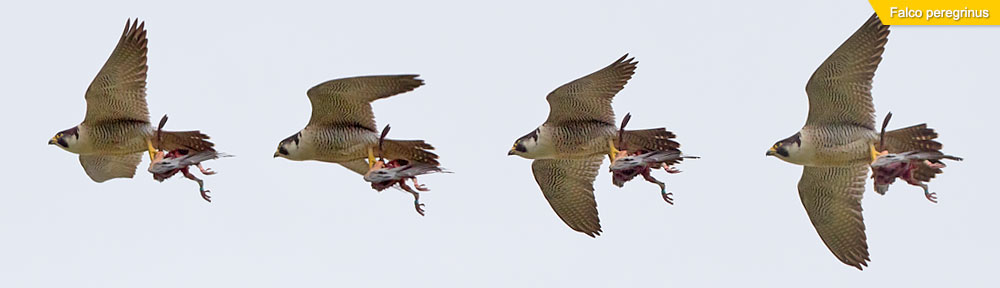
Two peregrines fledged in the area this year and could regularly be seen from the coast path over the summer – alternately terrorising the nesting seabirds on the cliffs below and testing their new wings in mock aerial combat with each other, and with their increasingly unamused parents.

Hobby Hawking

A former boating lake beside the A3 dual-carriageway in Surrey around rush-hour is not the first place you’d go looking for hobbies in the UK. But a pair of these young raptors fledged in the area this summer on land managed by the Surrey Wildlife Trust.

I’ve had good views of hobbies in Dorset before as they pursue their favoured dragonfly food, and whilst it’s reasonably easy to capture them eating their prey mid-flight, snapping the fleeting moment in which they close in and grasp their nimble prey is another matter.

On this particular gloriously warm and sunny September afternoon I sat by the lake shore and waited as a pair of birds arrived from the neighbouring heathland and began one of many bombing runs up and down the lake in front of me.

A handful of shots managed to freeze this aerial ballet between predator and would-be prey for a moment:

This slideshow requires JavaScript.

When one of the hobbies paused from the fray in the branches of a pine overlooking the lake it was even joined by a sparrowhawk, which must have been studying its technique with some envy:

Hobby and sparrowhawk

Hobby and female sparrowhawk

To the victor, the spoils:

Hobby with dragonfly prey

Hobby with dragonfly prey

Talbot Heath Inquiry

Photographic survey for RSPB and Natural England for use at public inquiry

Talbot Heath lies largely unnoticed on the outskirts of Poole in Dorset. Once it formed a seamless whole with the famous expanse of heathland familiar to Thomas Hardy and his contemporaries. Nowadays it’s sliced apart by bypass and railway to north and south, and nibbled away at by encroaching residential developments to the east and west. The sea of heathland has become an island here.

Most of the locals clearly love this precious green (and brown) open space, but its close proximity to human habitation regularly puts the heathland flora and fauna at risk from fire and other degradations. The effects of arson in particular, but also the predations of local cats, litter and path erosion present a considerable threat to this Ramsar and SSSI designated site.

Planning breach

The local borough council in their wisdom recently approved a planning application to extend a housing development in the north, onto farmland which currently serves as a buffer between urban and heathland areas. This decision was controversial for several reasons, but especially because it appeared to override a government directive which prevented new developments within 400m of heathland sites.

The RSPB and other conservation bodies became worried that this development might set a dangerous precedent and the decision eventually went to a Public Inquiry. As part of their submission to the Inquiry I was asked to document the site photographically for the RSPB and their partners at Natural England.

Urban effects

Following 3 visits to the site in late spring 2011 I delivered a library of 300+ geolocated images, documenting the Talbot Heath landscape, its flora and fauna, human visitors, and urban effects.

This slideshow requires JavaScript.

Update: In February 2012 the proposed development was refused permission by the Secretary of State for Communities and Local Government.

Upton Heath Fire

In the scorchingly hot, dry month of June 2011, Upton Heath near Poole in Dorset caught fire. I happened to be on the Arne peninsula at the time, and recorded this video footage from the opposite side of Poole Harbour:

Fanned by strong winds, the fire spread rapidly to become the largest heathland blaze in Dorset for decades.

Upton Heath was home to some of the UK’s rarest wild creatures, including the smooth snake, sand lizard and dartford warbler.

Over the following few days I documented the aftermath of the fire for the RSPB and Natural England, with permission of the Dorset Wildlife Trust’s team on-site:

This slideshow requires JavaScript.

More images of the fire’s aftermath on my photographic site.

Picture Arne

My image of an osprey with freshly caught bass was Highly Commended in the RSPB’s Picture Arne photo competition judged by BBC TV presenter and naturalist Chris Packham:

Osprey with fish. Arne, Dorset.

The RSPB’s reserve at Arne lies on the shores of Poole Harbour in Dorset. The ospreys are regular visitors on their migration south to Africa for the winter.

Spherical Panoramas

I’m always interested in finding new ways to combine my photographic skills with interactive technology.

A couple of years ago I experimented with panoramic photos taken through a complete 360 degrees, stitched together, and then animated inside a Flash player to enable the user to scroll left or right and explore different aspects of the view. I incorporated these panoramas into a Google Maps interface, to provide a ‘virtual tour’ experience for the website of a local country park and nature reserve.

More recently I’ve taken this to its logical conclusion and stitched together full spherical panoramas, which not only scroll horizontally through 360 degrees, but also up to a ‘zenith’ in the sky and down to a ‘nadir’ beneath the viewer’s hypothetical feet, through 180 vertical degrees.

When viewed in a dedicated Flash or Shockwave player the effect is suitably immersive. Click the images below to be transported (requires Adobe Shockwave).

RSPB Lodmoor

RSPB Lodmoor 360° x 180° Panorama

And this wintry scene from RSPB Arne after an unusual snowy spell:

RSPB Arne

RSPB Arne 360° x 180° Panorama

To make this exercise worthwhile you ideally want plenty of interest in the upper and lower extremities of the scene. Architectural interiors work well for this reason, as do dramatic cloudscapes.

* Shockwave wizardry courtesy of SPi-V – developed by the very talented Aldo Hoeben.