Hornets

Hornet cleaning leg

Male hornet cleaning its front legs.

The hornet (Vespa crabro) is Britain’s largest wasp species.

They prey on other wasps, honey bees, flies, butterflies, moths and spiders.

Hornet predating solitary wasp

Hornet disassembles solitary wasp prey

Saplings are ring-barked to encourage sap flow, which is then collected.

Hornets drinking birch sap

Hornets drinking sap from stripped birch sapling.

Nests are usually in aerial situations, particularly inside hollow trees, but also in attics and outhouses.

Hornets returning to nest

Hornets entering and exiting nest in trunk of hollow pine tree (composite)

Hornets' nest

Abandoned hornets’ nest in outside toilet.

Despite their fearsome reputation hornets are actually remarkably docile creatures and I found them much less intimidating to photograph than their common wasp (“yellow jacket”) relatives.

Related links:

Buglife: Glow Worm Survey

Buglife are using my image in their postcard campaign to publicise a glow worm survey in Scotland this summer:

Glow worm postcard

Scottish Glow Worm Survey postcard

Glow worms are widely distributed in the UK, with records from the south of England up to the north of Scotland, but there have been very few Scottish records in recent years.

Related links:

Dorset Life: Hunters

A selection of my images illustrates an article about predatory animals and plants in the May edition of Dorset Life magazine, out this month.

Dorset Life magazine

Dorset Life: Dorset Hunters. Double spread I

Dorset Life magazine

Dorset Life: Dorset Hunters. Double spread II

Featured flora and fauna include: the kestrel, adder, red fox, otter, sundew, kingfisher and hornet robberfly. Words by Joël Lacey.

Available now at all good newsagents and supermarkets in the Dorset area!

Related links:


Adder Ecdysis

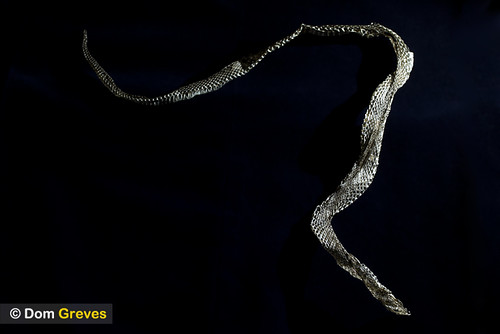
Complete adder skin

Complete sloughed skin of adder (Vipera berus)

Periodically snakes and other animals shed their entire skins, in a process known as ecdysis (or sloughing, or moulting).

Moulting takes up to 14 days to complete. The inner surface of the old skin liquefies, which causes it to separate from the new skin beneath it. By rubbing its skin on hard objects the end nearest the head begins to peel back on itself, until the snake is able to crawl out of its skin, turning it inside-out like a sock.

Head of adder skin

Head end of moulted adder skin

The ocular scale, or ‘brille’, is discarded along with the rest of the skin. This is essential for maintaining the snake’s quality of vision.

Ocular scale of adder

Adder skin showing ocular scale detail

The visually striking process of renewal exhibited by these animals is one reason why serpents have historically been symbolic of healing and medicine in our culture.

Adder skin

Adder skin with side illumination

Snake skin is formed from the remarkably adaptable substance keratin. Some of its properties are best appreciated in close-up:

Adder skin closeup

Backlit adder skin detail

Underside of adder skin

Underside of adder skin showing transparent keratin scales

This particular skin was found on heathland, woven in amongst some dried grasses. We later stumbled across a stunning, newly sloughed, caramel-coloured female sunning herself nearby.

Related links:

Butterfly Conservation Moth Report

Butterfly Conservation: Moth Report 2013

Butterfly Conservation: Moth Report 2013

Butterfly Conservation used my image of a nocturnal moth trapping event to illustrate their latest report:

Unsurprisingly the report concludes that UK moth numbers are in decline, documenting a 40% drop in total abundance in the south of England over the last 40 years.

On the bright side many more moth species have colonised Britain in recent decades than have become extinct.

This photograph was taken at a recent moth trapping event on Chatley Heath organised by Surrey Wildlife Trust. The original image below:

Moth Trap Assembly

Skinner Trap on Surrey heathland at night

Related Links:

Suburban Oak

Suburban Oak

The ancient Crouch Oak in Addlestone, Surrey, UK

The Crouch Oak once marked the perimeter of Windsor Great Park and is thought to date from the 11th Century, making it in excess of 900 years old.

This ancient tree now looks a little incongruous as a modern residential estate has grown up around it.

Night Oak

The Crouch Oak at night with passing traffic

It’s interesting to compare depictions of this tree from the 19th Century and in 1904 as wooden fences are replaced with metal railings and a dusty track becomes a surfaced road. The oak also enjoyed an additional limb in those days.

In more recent times the Crouch Oak survived an arson attempt in 2007 and is now fitted with metal grilles across its hollow openings to prevent a repeat.

Oak Urban Effects I

Metal grille stops burning objects being thrown inside

To see the Crouch Oak for yourself follow the map below to the bend in Crouch Oak Lane:

Related Links:

Dartford Warbler Winter

Dartford Warbler Snow Drift

Dartford warbler (Sylvia undata) foraging on snow covered heathland

In the severe winter of 1962/63 the Dartford warbler (Sylvia undata) was almost wiped out in Britain. The national population dropped to just 10 pairs.

But in good breeding seasons, and with suitable habitat, its numbers are capable of bouncing back, thanks to repeated nesting and high survival rates among its offspring.

On the Surrey lowland heaths Dartfords have been doing well, re-colonising Thursley Common last year for the first time since a devastating fire in 2006.

During the recent freezing winter weather I photographed this Dartford warbler foraging in the snow on Chobham Common:

Dartford Snow Flurry

Dartford Snow Dipper

Related Links:

RSPB Panels

Interpretation panels
Interpretation panels at RSPB Arne

The RSPB’s reserve at Arne in Dorset recently requested the use of my wetland wildlife photos for their new seasonal interpretation panels. They also commissioned a stitched panoramic landscape image to highlight landmarks visible from their stunning observation point overlooking Poole Harbour.

Featured above are the Southern Hawker dragonfly, Osprey, Wasp Spider, Raft Spider and Marsh Harrier, all of which can be found on the Arne reserve at different times of the year. Well worth a visit!

Raft Spider Life Cycle

Raft spider on pond surface

Raft spider on pond surface

You’d think that arachnids and water was an unhappy combination, but one species of European spider has made boggy ponds their home.

The raft spider (Dolomedes fimbriatus) is the UK’s largest native spider – its body growing up to 2cm long.

It uses the water’s surface like other spiders use their webs – feeling for the vibrations of potential prey with front legs extended. Using this technique it hunts tadpoles, insects and occasionally small fish:

Raft spider eating damselfly

Raft spider eating damselfly

When alarmed, the water repellent hairs on the raft spider’s legs enable it to dive beneath the water, trapping a bubble of air to keep it alive until the coast is clear and it cautiously re-emerges:

The wetland pools favoured by raft spiders are increasingly rare in this country. On the RSPB’s Arne reserve in Dorset their habitat is lovingly preserved, and offers wildlife watchers easy access from the nearby heathland trail:

Boggy pond habitat

Boggy pond habitat

On a good day dozens of raft spiders at various stages in their life cycle can be witnessed at the pond’s edge.

1. Sex

The female raft spider is often considerably larger than the male and mating is a dangerous business. He approaches her cautiously, waving his front legs tentatively to judge her receptiveness:

Male raft spider approaches female

Male raft spider approaches female at her den

She may rush out to scare him off on numerous occasions, after which she retreats and the process begins again, the male edging closer all the while. It’s a nerve jangling thing to watch, let alone participate in.

2. Birth

The female spins a silk bag to contain the fertilised eggs, which she carries about beneath her body, keeping it just warm and moist enough to ensure their survival:

Raft spider carrying egg sac

Raft spider carrying egg sac

Then, when the baby spiders are ready to hatch, she lashes the egg sac to vegetation at the edge of the pond and the tiny hatchlings emerge:

Baby raft spiders in nursery web

Baby raft spiders in nursery web

Mum typically lies in wait nearby to ensure that her young ones don’t come to any harm:

Raft spider guards her hatchlings

Raft spider guards her hatchlings

This phenomenon of hundreds of spiderlings crowded together for their own mutual safety is only really appreciated up close:

Raft spider hatchlings

Raft spider hatchlings closeup

But soon the young raft spiders are large enough to fend for themselves and disperse around the pond.

3. Death

Raft spiders are not fussy eaters. When times are tough and food is scarce, or when too many raft spiders compete for the same local resources, they may even turn to cannibalism:

Not such a pretty sight!

Related links:

An Audience With The Purple Emperor

Purple Emperor Banquet

Purple Emperor butterfly (Apatura iris) feasting on fresh dog turd

Such a beautiful creature with such un-photogenic habits! Infamously the Purple Emperor butterfly (Apatura iris) spurns the sweet nectar of wildflowers in favour of dog faeces amongst other delicacies.

Now mostly confined to the ancient deciduous woodlands of Surrey and Sussex in the UK, the Purple Emperor has a devoted following in the world of butterfly fans.

Normally it flies high in the woodland canopy and only occsionally will the male descend to the ground to replenish its liquids and salts in this peculiar fashion.

On these rare occasions the Emperor’s acolytes fill their boots.

Here on Bookham Common in Surrey, within sight and sound of the M25 motorway, the lack of a long lens is no handicap when this butterfly is distracted by a fresh deposit:

Purple Emperor Phone

Purple Emperor posing for a mobile phone photograph

The less exotically coloured female at least has more refined tastes, and generally remains high in the oak trees feeding on the sticky sweet honeydew secreted by aphids. She returns a little closer to earth only to lay her eggs in a suitable sallow tree nearby.

Purple Emperor Laying

Female Purple Emperor laying eggs on willow sapling

Such is the lure of the Purple Emperor that fanatics have been known to entice ‘His Majesty’ down from the trees with a number of foul smelling concoctions. In the absence of dung a rotting carcass may occasionally do the trick. This recently deceased rodent at a favourite butterfly haunt in the wood may have benefited from a coroner’s inquest:

Suspicious Death

Suspiciously well placed mouse carcass!

Related Links: